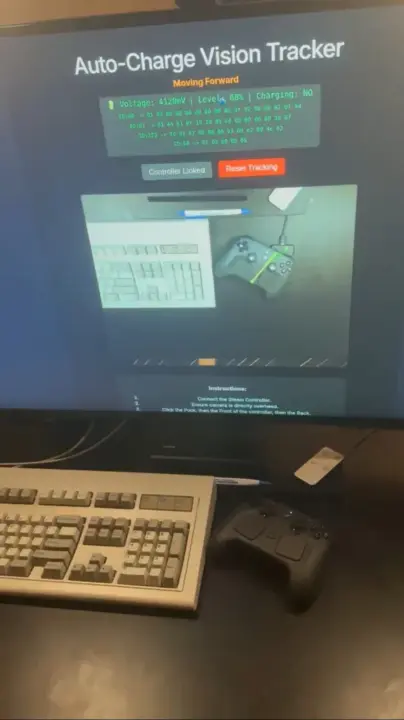
A community project now allows the Valve Steam Controller to find its own charging puck without manual intervention. This development matters to owners of the peripheral because it removes the friction of placing the device on a dock every time the battery runs low. The solution turns a passive accessory into an active participant in its own power cycle.
Open-source software uses haptic feedback to move the device toward its dock
The system relies on open-source software developed by community member Ray Foss. Users install the code on a host machine connected to an overhead camera that watches the controller's location. The software calculates the exact position of the device relative to the charging puck in real time.
The core mechanism uses the controller's built-in haptic motors to generate physical movement. Instead of rolling or sliding, the controller vibrates its internal components to shift its weight and roll toward the puck. This haptic navigation replaces traditional wheels or tracks with simple vibration-based locomotion.
Setup requires a one-time calibration where users define the tracking points for the camera and puck. The software saves these coordinates automatically so the process does not need to repeat. The entire project is available as open-source code on GitHub for anyone to review or modify.
This project demonstrates how community engineering can extend the utility of older hardware like the Steam Controller. Users with the peripheral can now download the software and build the tracking setup to automate charging. The solution offers a practical fix for a common annoyance without requiring new hardware purchases.
Source: SteamDeckHQ