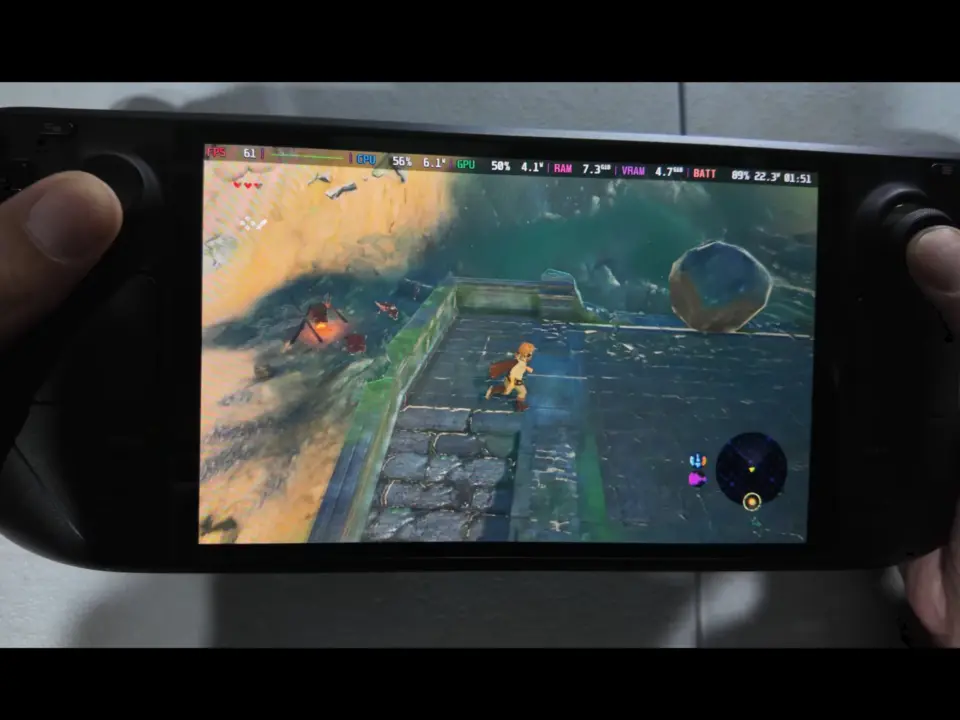
Nintendo's flagship open world game works natively on the Steam Deck without going through the old tried and true emulation platform you've been used to over the years. It's important because that's a significant performance loss point that's been removed in order to let you play Hyrule at higher frame rates with less system overhead.
Native recompilation removes emulation overhead for stable high framerates
This is being done thanks to a game recompilation process that converts the game code to be natively executable on the deck hardware. The Savage Wind Recomp project allows this to happen through a process that takes the original game files and re-compiles them in a way that the game will run natively on the Steam Deck's linux based OS.
You'll need to download the Alpha 4 update (November 1) and provide your own The Legend of Zelda: Breath of the Wild 1.9.0. It's done as a Linux AppImage which means you have to put the Steam Deck into desktop mode to run it.
Tests show that the game is running at 50-60 fps pretty solidly in the first few areas of the world. And it's running natively in a much more stable fashion than you'd normally get when going through emulation.
It also supports the 2 big expansion packs (Master Trials and The Champions' Ballad) so you'll have access to everything as well. We don't yet have later game footage, so we don't know if the game remains stable out of the initial starting area or not.
But for what we've got right now it seems like it's an impressive feat. However it could still start dropping performance for extended periods of time or have bugs in tougher parts.
If you're interested in this method you'll have to be willing to handle your own game files and run it in a non-typical way. This native game is a big leap forward for handheld play.
It's a cleaner way to play this particular game without having to emulate. The Legend of Zelda: Breath of the Wild now runs natively on the Steam Deck hardware, with stable high framerates verified in early game.
Source: Zelda, NotebookCheck


Discussion
0 comments