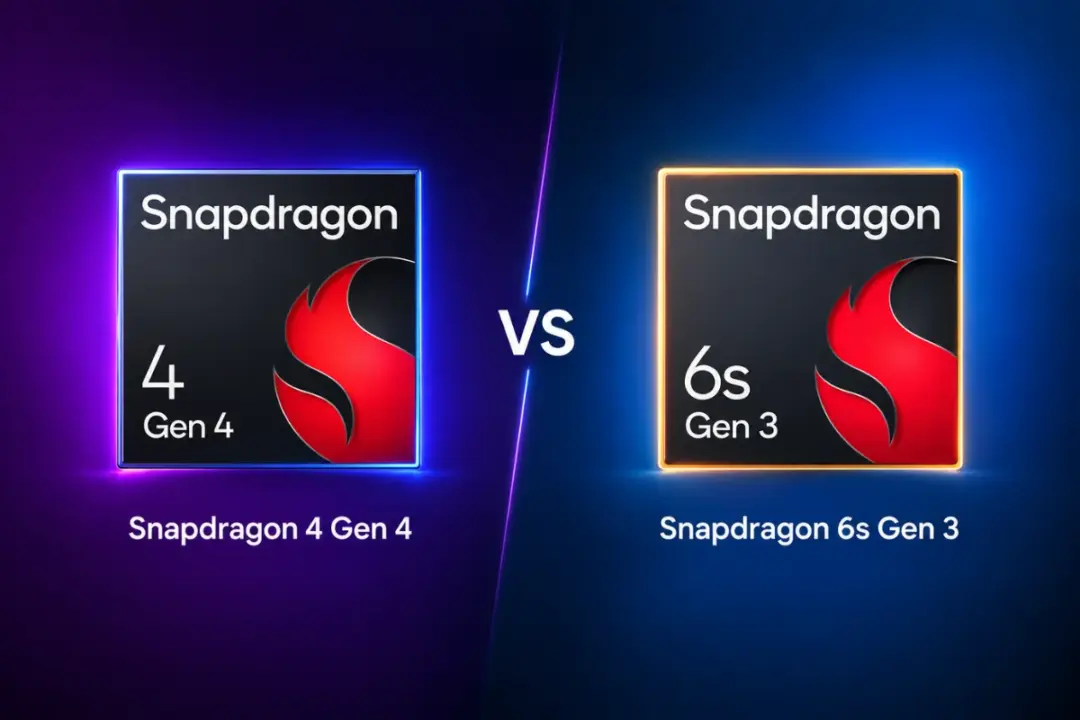
Qualcomm Snapdragon 4 Gen 4 is a new chipset aimed at budget smartphones. It's designed to be efficient with memory and stay up-to-date with modern connectivity. It's a great option for users wanting 5G on a budget, balancing power and efficiency. It's moving away from older memory technologies to speed up data handling, which affects how apps perform daily.
Qualcomm's latest budget SoC prioritizes memory bandwidth and storage speed over raw graphics power
The system-on-chip includes a hybrid CPU architecture based on Samsung's 4nm process node. It combines two powerful Cortex-A78 cores at 2.3 GHz and six efficient Cortex-A55 cores at 2.0 GHz. This setup is all about keeping things cool and energy-efficient for budget smartphones.
Spec comparison
| Spec | Snapdragon 4 Gen 4 | Snapdragon 6s Gen 3 |
|---|---|---|
| Process Node | 4nm (Samsung) | 6nm |
| GPU Performance | Base (Adreno 613) | 67% higher |
| Memory Performance | 18% higher | Base (LPDDR4X) |
| Storage Support | UFS 2.2, UFS 3.1 | UFS 2.2 |
For graphics, it features the Adreno 613 GPU running at 1010 MHz. Memory speeds are upgraded with support for LPDDR5 RAM up to 3.2 GHz. Storage also gets a boost with UFS 2.2 and UFS 3.1, meaning faster data transfers and smoother game loads than before.
There's a Snapdragon 5G modem for sub-6 GHz connectivity. According to the POCO M8 Power 5G, Geekbench shows a single-core score of 958 and a multi-core score of 2335. In AnTuTu v11, it scores 619,402 for total performance, giving it a decent foundation for multitasking in mid-range devices.
When compared to the Snapdragon 6s Gen 3, it's clear there are differences. The 6s Gen 3 is 67% faster for GPU performance but is using older 6nm and LPDDR4X memory. Meanwhile, the 4 Gen 4 provides 18% more memory performance and better efficiency thanks to the 4nm process, making it more modern and battery-friendly despite lower graphics performance.
Source: GIZMOCHINA



Discussion
0 comments