Bot scraping has fundamentally altered the landscape for DDR5 memory buyers, turning what should be a straightforward purchase into a competition against automated scripts. This shift matters because it drastically reduces the likelihood of securing stock at retail prices, effectively locking out human shoppers from the market. The volume of automated activity now dwarfs legitimate consumer interest, creating a barrier to entry that did not exist in previous hardware cycles.
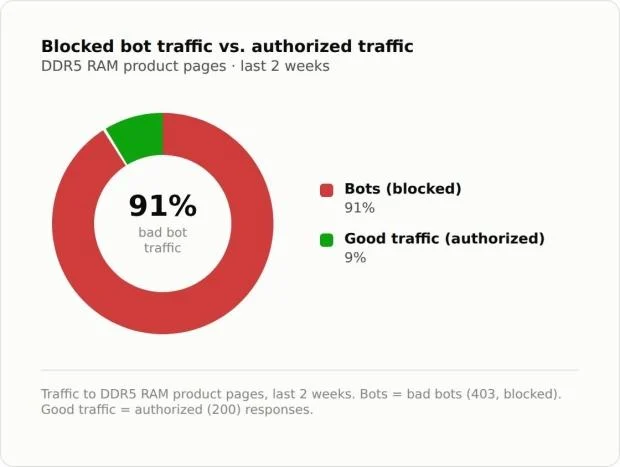
Automated scripts now account for 91% of visits to DDR5 product pages
DataDome, a bot-mitigation firm, analyzed traffic patterns on a single unnamed retailer's product pages and found that 91 percent of visits originated from automated tools. This ratio translates to roughly ten bot requests for every one legitimate customer visit. The data highlights a severe imbalance in demand signals, where automated scripts dominate the digital shelf space intended for actual consumers.
The intensity of this scraping activity is evident in specific metrics from a one-hour observation window. During that period, 91 unique DDR5 listings were scraped an average of 551 times each. One individual bot operation generated over 50,000 requests per hour before being blocked by security measures. DataDome reports blocking more than 10 million scraping attempts in total across its network.
This automated pressure extends beyond consumer retailers to industrial memory suppliers and component manufacturers like Amphenol and TE Connectivity. The scraping targets the entire supply chain, not just the final sale point. AMD warned in June that DDR5 prices will not recover until 2028 because AI demand continues to pull supply away from consumer markets. This supply constraint compounds the difficulty of finding stock, as bots compete for a shrinking pool of available units.
It is important to clarify that the 91 percent figure reflects page requests rather than completed purchases. Page requests are not purchases, so the number indicates how aggressively bots are watching listings rather than how much stock they are actually grabbing. The statistic comes from a single unnamed retailer, and DataDome has not shared its sample window or full methodology. Consequently, the figure may not represent the entire DDR5 market globally.
Source: TweakTown