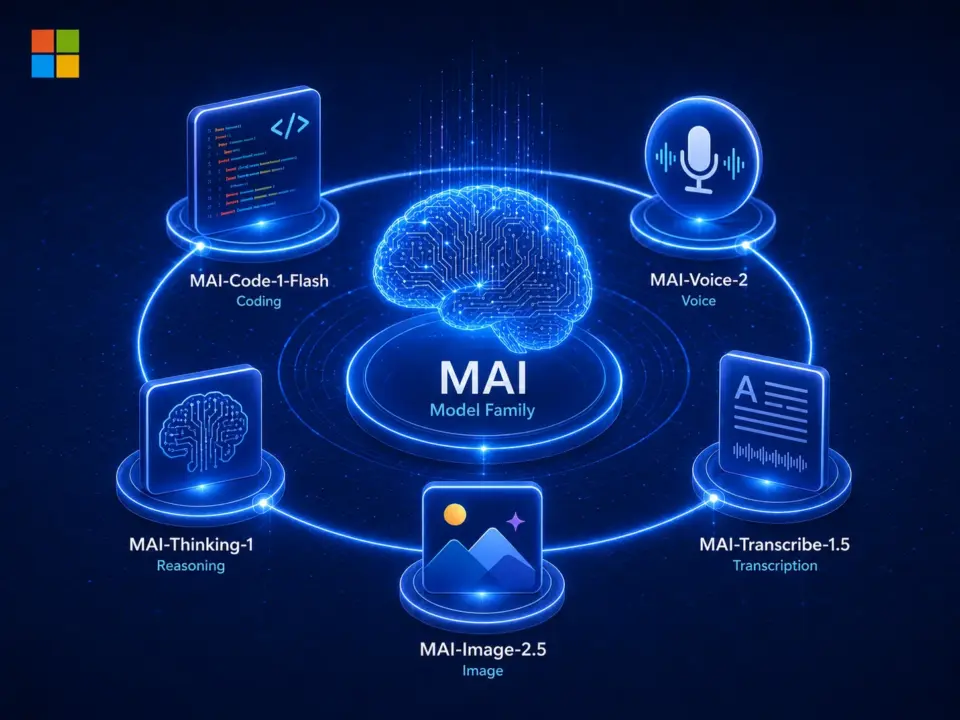
Microsoft has entered the advanced-reasoning AI race with MAI-Thinking-1, its first in-house reasoning model. The company claims the model outperforms Claude's Sonnet 4.6 in blind human evaluations. This move signals Microsoft's ambition to compete directly with leading AI labs.
MAI-Thinking-1 leads a family of seven models
MAI-Thinking-1 is part of a family of seven AI models developed by Microsoft. The lineup includes MAI-Code-1-Flash, MAI-Transcribe-1.5, MAI-Image-2.5, and MAI-Voice-2. Each model targets a specific domain, from coding to transcription and image generation.
- MAI-Code-1-Flash active parameters: 5 billion
- MAI-Transcribe-1.5 speed improvement: 5 times faster than comparable models
- MAI-Transcribe-1.5 language support: 43 languages
- MAI-Voice-2 language support: 15 languages
MAI-Code-1-Flash uses 5 billion active parameters for efficient code generation. MAI-Transcribe-1.5 claims to be the best transcription model worldwide, running five times faster than comparable models. It supports 43 languages. MAI-Voice-2 generates natural audio and voice in 15 languages.
Frontier Tuning adapts models to enterprise needs
Microsoft introduced 'Frontier Tuning' to adapt models to specific company needs using secure customer data. The MAI model tuned for Excel reportedly matches GPT 5.4 and is up to 10 times more efficient. MAI-Image-2.5 is said to score higher in Arena than Nano Banana Pro.
Microsoft's ultimate goal is 'Humanist Superintelligence' to serve people and organizations. The company has not disclosed pricing or availability for any of the models. All performance claims come from Microsoft and lack independent verification.
The MAI family covers reasoning, code, transcription, image, and voice tasks. Microsoft positions these models as versatile tools for enterprise and developer use. Confirmed details include the model names, parameter counts, and language support figures.
Source: MAI-Thinking-1, NotebookCheck