AMD has expanded its Ryzen APU lineup with 11 new chips, a move that adds more options for laptop manufacturers but creates confusion for buyers trying to match model numbers to performance. The new Ryzen 200 and 100 series parts use different underlying architectures, which means the naming convention no longer reliably indicates the silicon generation. We need to look closely at the specs because the Ryzen 100 series listings contain conflicting technical details that make it hard to know exactly what you are buying. This expansion gives system builders more flexibility, but it requires consumers to verify specific SKUs on manufacturer pages rather than relying on the model number alone.
Conflicting specs in Ryzen 100 series obscure silicon generation
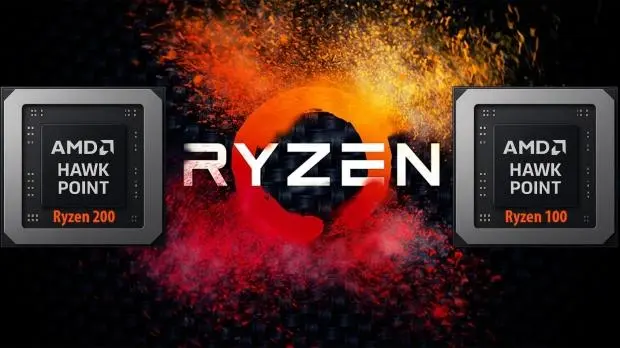
The Ryzen 200 series introduces seven new SKUs: the Ryzen 3 205, Ryzen 5 216, Ryzen 5 224, Ryzen 5 225, Ryzen 7 217, Ryzen 7 249, and Ryzen 7 253. These processors are built on the Hawk Point platform and utilize Zen 4 cores, with some models pairing Zen 4 cores with Zen 4c cores in hybrid configurations. All Ryzen 200 series parts include RDNA 3 graphics, which provides a consistent baseline for integrated graphics performance across this new generation. This architectural consistency makes the 200 series easier to evaluate for performance expectations.
- New Ryzen 200 Series SKUs: Ryzen 3 205, Ryzen 5 216, Ryzen 5 224, Ryzen 5 225, Ryzen 7 217, Ryzen 7 249, Ryzen 7 253
- Ryzen 200 Series Architecture: Zen 4 cores, some paired with Zen 4c in hybrid configurations, alongside RDNA 3 graphics
- New Ryzen 100 Series SKUs: Ryzen 9 180, Ryzen 7 165, Ryzen 7 155, Ryzen 5 125
- Ryzen 100 Series Conflicting Specs: Listed as Hawk Point parts on a 4nm process with RDNA 3 graphics, while simultaneously tagged as Zen 3+
In contrast, the Ryzen 100 series adds four new chips: the Ryzen 9 180, Ryzen 7 165, Ryzen 7 155, and Ryzen 5 125. AMD's product pages list these parts as Hawk Point chips on a 4nm process with RDNA 3 graphics, which aligns with the Zen 4-era silicon used in the 200 series. However, the same pages simultaneously tag these models as Zen 3+, creating a direct contradiction in the official specifications. This conflicting information suggests that the Ryzen 100 series might be a mix of Rembrandt (Zen 3+) and Hawk Point (Zen 4) silicon, but AMD has not clarified which specific chips use which architecture.
The current naming strategy obscures the underlying silicon generation, making it difficult for consumers to distinguish between older and newer technology based on the model number alone. This approach mirrors Intel's Core Ultra 200 strategy, where the naming convention no longer directly maps to a specific microarchitecture or performance tier. We advise checking the exact specifications on manufacturer pages for any laptop you consider, as the model number alone does not guarantee the processor generation. The lack of clarity in the Ryzen 100 series listings is the primary takeaway for anyone shopping for new hardware.
Source: TweakTown