Square Enix released a gameplay guide for the Shadowblood Queen, the final opponent in Final Fantasy VII Rebirth's Queen's Blood card game. The boss becomes available only after players defeat 29 other ranked combatants and uses mechanics that break standard rules to challenge experienced players.
Recommended deck and row control strategy for the final card game boss
The Shadowblood Queen starts with her own card already placed on the board and summons cards of any rank on any pawn she controls. Her spawns enfeeble both players' cards while simultaneously powering up herself, which forces players to build a specialized deck rather than relying on standard strategies.
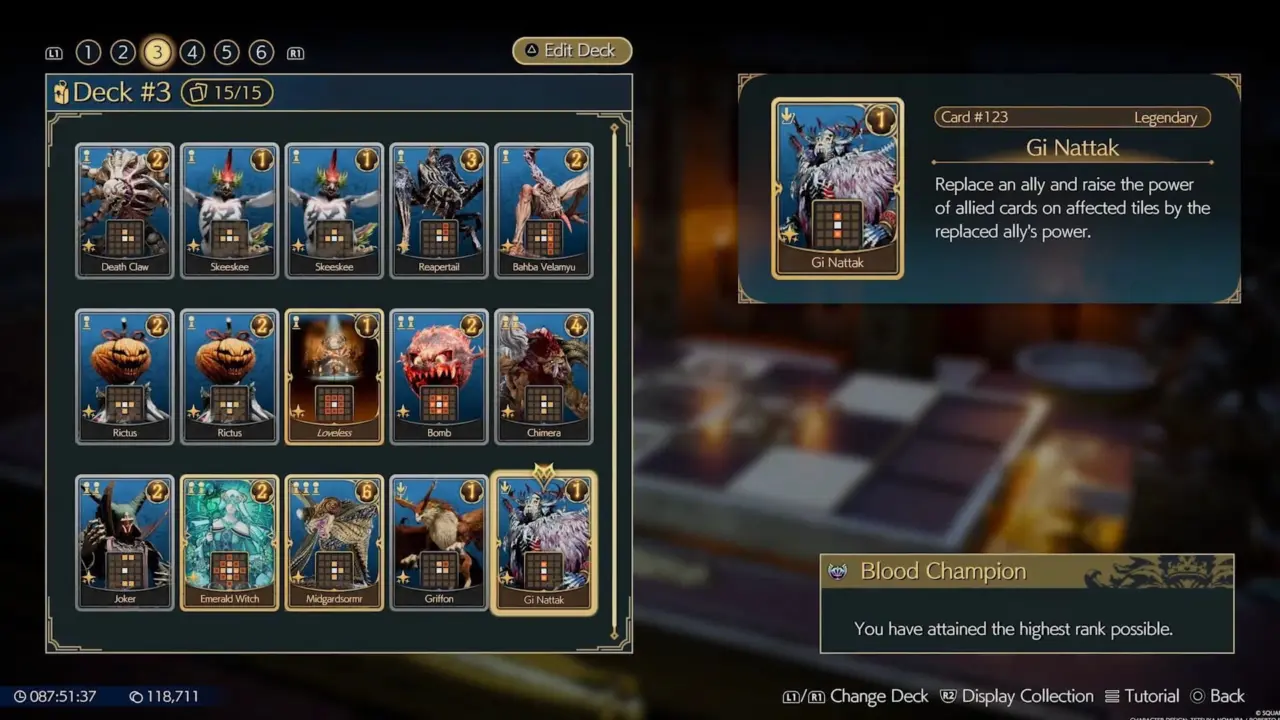
A recommended deck includes Death Claw, two Skeeskee cards, Reapertail, Bahba Velamyu, two Rictus cards, Loveless, Bomb, Chimera, Joker, Emerald Witch, Midgardsormr, Griffon, and Gi Nattak. The strategy focuses on winning the top and bottom rows by leveraging enfeeblement to boost Rictus and Chimera power, then using Gi Nattak to transfer Chimera's accumulated power to the Rictus cards.
Rictus raises its own power by one point every time an ally or enemy becomes enfeebled. The Chimera card increases its power by two points for each enfeebled enemy. Gi Nattak replaces a card on the field and grants that card's power to the allies directly above and below it, which serves as the core mechanism for concentrating damage in specific rows.
Players should aim for an ideal starting draw featuring at least one Rictus and a Chimera. The first column typically starts with a Rictus at the top, followed by a Chimera in the middle slot, and a second Rictus in the bottom slot to protect these key cards from early enfeeblement effects.
The final battle requires players to abandon the middle row to the Shadowblood Queen while using cards like Skeeskee, Emerald Witch, and Loveless to manage board control. Bahba Velamyu can enfeeble enemies upon death to further stack Rictus power, and Reapertail works similarly to stall until the opponent runs out of playable cards.
Video Games Chronicle reported that a successful run can result in totals of 23 points in the top row and 22 points in the bottom row for a combined total of 45, which beats the middle row's 33-point Shadowblood Queen card. The guide confirms this specific deck composition and power transfer strategy as the most reliable method to defeat the final opponent.
Source: FF7 Rebirth, VideoGameChronicles