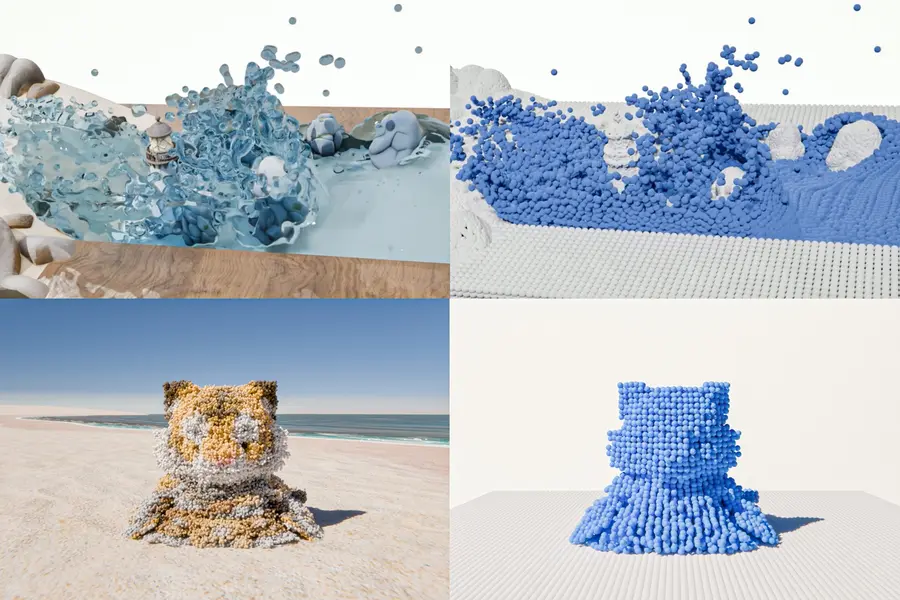
MIT has just come out with a new AI that simulates reality called WorldParticle. Why does this matter? Because it is bringing us closer to having a unified way to simulate complex physical interactions across various industries.
New AI model unifies six physical phenomena for faster drug discovery
Rather than having to create specific equations for each specific case, this AI is able to predict motion states using a single approach. This can make things more efficient for various fields, from drug discovery to gaming.
The heart of the new WorldParticle is that it uses 3D particles to represent matter. The AI doesn't actually try to solve the normal equations of physics for different types of matter. Instead, the AI is able to predict how the particles would behave and interact over time. This is a general approach that can simulate a large array of different physical phenomena without needing to reprogram.
The AI can simulate six different types of physical phenomena. This includes things like granular matter, liquids, deformable solids. The AI can also simulate how proteins move, which is important in biological fields. It does this by treating these different states as different versions of a fundamental particle behavior.
According to MIT, the protein movement simulations are 100x faster than traditional methods. This is very important for researchers wanting to look at complex interactions of molecules. With this new speed of processing, it's possible to do much more extensive testing and exploration of possible drugs. It's a great example of why AI for physical simulation can be an important tool.
WorldParticle is a step towards unified physical models of reality. By merging various kinds of simulations into a single framework, MIT is making it so we don't need so many special tools. For now, WorldParticle is a research tool intended for academic and industrial use. The wide array of phenomena that it can capture suggests that it may have widespread potential in the future.
Source: NotebookCheck



Discussion
0 comments