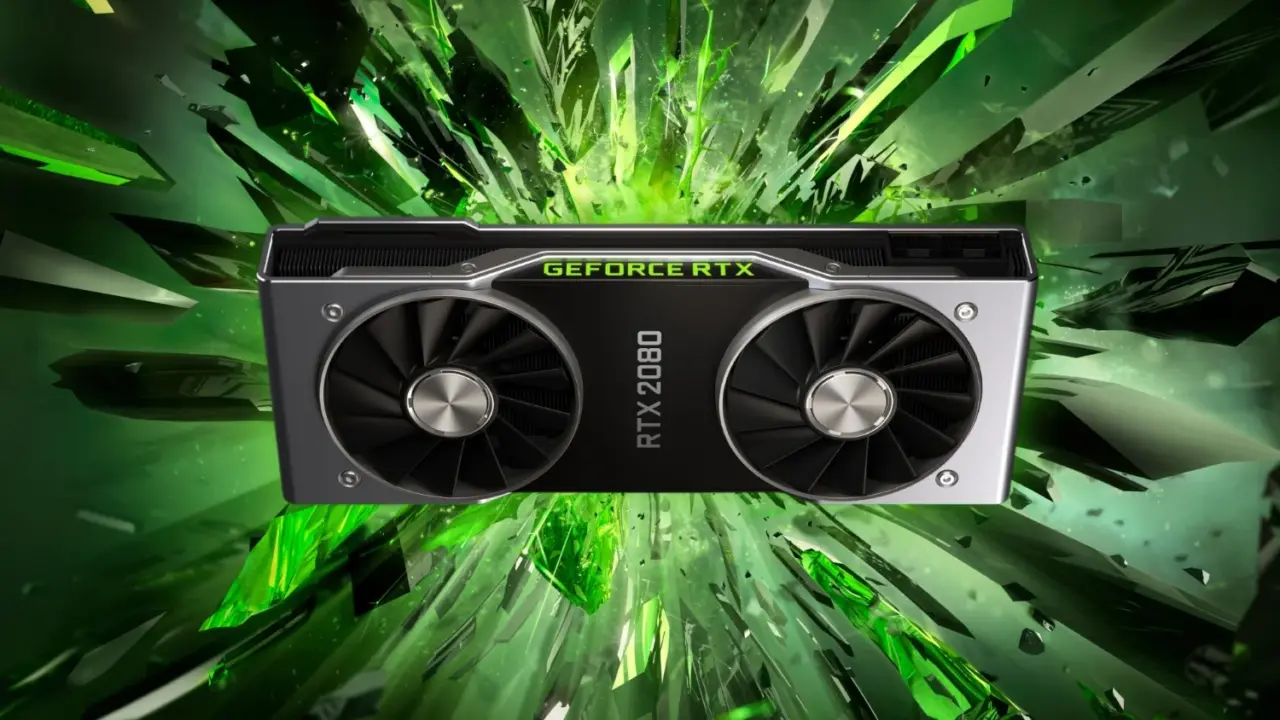
Eight years ago, NVIDIA launched the GeForce RTX 2080 and fundamentally changed how PC gamers render images. This release marked the beginning of the Turing architecture and introduced real-time ray tracing to consumer hardware. The shift matters because it established a new visual standard that modern games still rely on today.
Turing architecture introduced ray tracing and DLSS to consumer hardware
The baseline GeForce RTX 2080 featured 2,944 CUDA Cores and 8GB of GDDR6 memory on a 256-bit bus. NVIDIA positioned this card alongside the higher-end RTX 2080 Ti, which offered 4,352 CUDA Cores and 11GB of GDDR6 memory. These specifications defined the initial entry point for the new generation of graphics processing units.
Specifications
- CUDA Cores (RTX 2080 Ti): 4,352
- Memory (RTX 2080 Ti): 11GB GDDR6
- CUDA Cores (RTX 2080): 2,944
- Memory (RTX 2080): 8GB GDDR6
- MSRP (RTX 2080 Ti): $999 USD

The RTX 20 Series introduced dedicated RT and Tensor Cores to handle ray tracing and DLSS workloads. Day-one software support lacked these features, but Battlefield V added ray-traced reflections in November 2018. Metro Exodus and Control followed in 2019 to provide the first true ray tracing experiences for players.
DLSS 1.0 required per-game training to function, but DLSS 2.0 became the standard performance booster in early 2020. By 2026, DLSS 3, 4, and 4.5 allow older RTX 20 Series cards to maintain performance in modern titles. This evolution ensures that the hardware launched in 2018 remains relevant for current gaming demands.
The GeForce RTX 2080 launched with an MSRP of $699 USD. The RTX 2080 Ti carried an MSRP of $999 USD. These prices set the baseline for premium graphics cards during the Turing generation.
Source: TweakTown
Discussion
0 comments