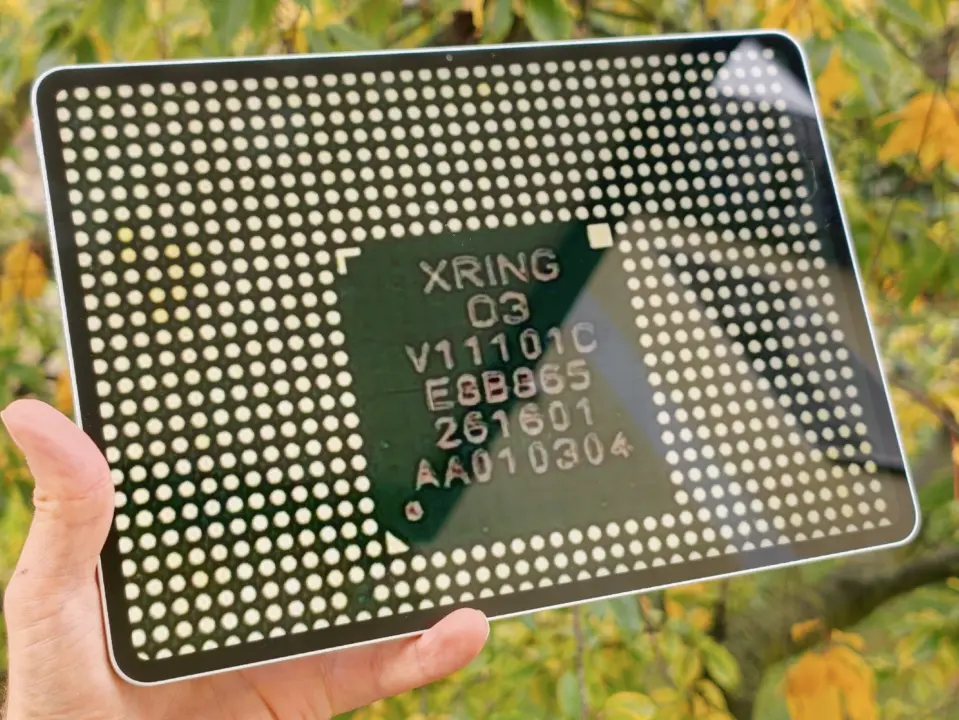
Xiaomi Pad 9 Pro Max with new proprietary Xring O3 SoC revealed. The significance of the release is that this hardware focuses on achieving high end performance benchmarks that are typically the domain of Apple and Google silicon. If you want the most out of your tablet experience in terms of raw CPU and GPU performance you now have this alternative with well-defined performance specs.
Xiaomi's new Xring O3 SoC dominates synthetic benchmarks while lagging in AI tasks
The Xiaomi Pad 9 Pro Max is powered by Xiaomi Xring O3 SoC. It uses Mali G2-Ultra NX MP16 GPU. This allows the device to compete with M-series of Apple and Tensor from Google in the synthetic benchmarks. Clearly here the emphasis is on sustained graphic performance and fast multi core performance.
Specifications
- SoC: Xiaomi Xring O3
- GPU: Mali G2-Ultra NX MP16
- Geekbench 6 Multi-Core: 12976 Points
- Geekbench 6 Single-Core: 3522 Points
- 3DMark Wild Life Unlimited: 31077 Points
The Geekbench 6 multi-core test for Xring O3 gives us 12976 points. This makes it more than 50% faster than Google Pixel 10 Pro in the same test. The single core performance is 3522.
In 3DMark Wild Life Unlimited the GPU score is 31077. The device clocks 85 FPS in GFXBench 4K Aztec Ruins offscreen tests.
The device has 512 GB of flash memory. It's UFS 4.1 for data storage. The Xring O3 is not that great for AI acceleration.
It lags behind Apple M4/M5 in certain AI benchmarks. This indicates that generative AI tasks may not benefit as much as raw compute from the hardware.
Xiaomi Pad 9 Pro Max starts from around $1000 for the global market. This makes it a premium offering against the existing high end tablets. We wrote about Xiaomi Redmi 17 5G in our battery life analysis. But now the company has a substantial performance oriented offering in their current portfolio with Pad 9 Pro Max.
Source: NotebookCheck



Xring O3 destroys the Pixel 10 Pro in multi-core benchmarks. Raw CPU power is the only metric that matters here.