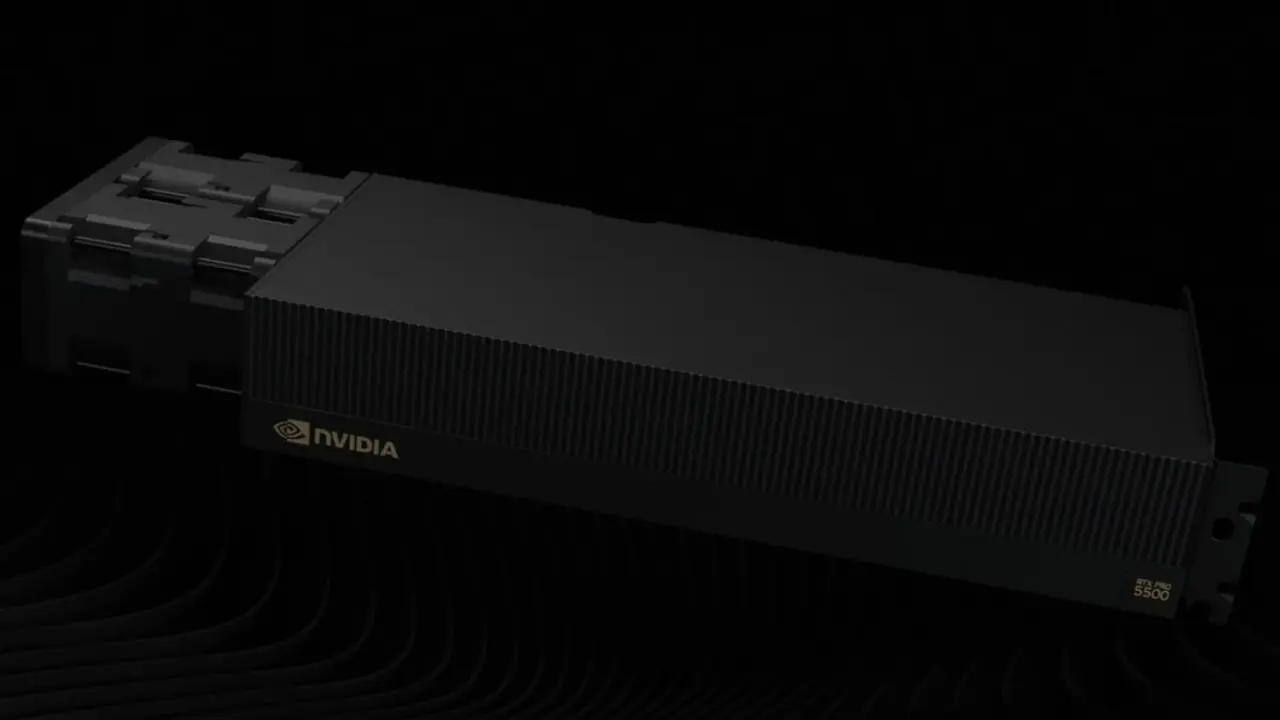
NVIDIA has revealed the RTX PRO 5500 Blackwell, a new workstation GPU that brings flagship-level memory capacity to a more accessible form factor. This release matters because it offers 84GB of ECC GDDR7 memory, which directly addresses the growing demand for running large local language models on single-GPU setups. Professionals who previously needed expensive multi-GPU configurations can now consider this card for memory-intensive tasks.
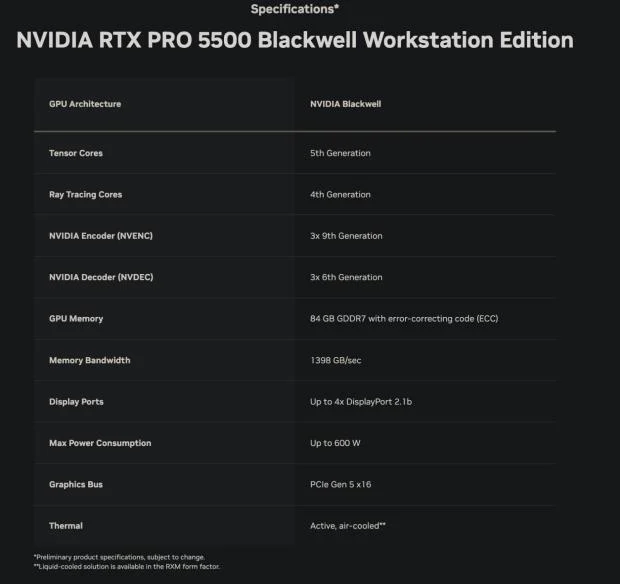
Workstation card offers 84GB VRAM for local AI workloads
The card is built on a cut-down version of the GB202 GPU, the same architecture found in the GeForce RTX 5090. It features 21,760 CUDA cores distributed across 170 streaming multiprocessors. This core count matches the consumer flagship, but the RTX PRO 5500 prioritizes memory bandwidth and error correction over raw gaming performance.
Specifications
- GPU Architecture: Blackwell (GB202)
- CUDA Cores: 21,760
- Memory Capacity: 84GB
- Memory Type: GDDR7 ECC
- Memory Bandwidth: 1.4 TB/s
Memory is the defining feature of this hardware, with 84GB of GDDR7 providing nearly 1.4 TB/s of bandwidth. The GPU supports Multi-Instance GPU (MIG) technology, allowing users to split the VRAM into two 42GB instances for isolated workloads. It also includes three NVENC encoders and three NVDEC decoders for heavy video processing tasks.
Power consumption is rated at up to 600W, which matches the thermal design power of the higher-end RTX PRO 6000. The card uses a PCIe 5.0 x16 interface and provides four DisplayPort 2.1b outputs for high-resolution displays. NVIDIA currently lists the specifications as preliminary, so final details on memory configuration may change before launch.
Pricing and specific availability dates have not yet been disclosed by NVIDIA. The product is currently listed as coming soon for global release. We looked at Nvidia RTX 50 Super Series Launch in our earlier Nvidia coverage to track related Blackwell developments.
The RTX PRO 5500 Blackwell establishes a new baseline for single-GPU workstation memory capacity. It targets users who need large VRAM pools for AI and rendering without investing in dual-GPU systems. Buyers should wait for official pricing and final spec confirmation before making purchasing decisions.
Source: TweakTown

Discussion
0 comments