
We are looking at a significant shift in how dense 3D environments are rendered, specifically regarding ray tracing performance. AMD has demonstrated a new technique that drastically reduces the computational load required for complex scenes. This development is significant because conventional ray tracing frequently encounters performance bottlenecks when rendering scenes with high object counts, which can cause frame rate instability in graphically intensive titles. The new approach aims to make these heavy scenes run smoothly on consumer hardware without requiring massive memory overhead.
New tetrahedral cages method drastically reduces VRAM and BVH update times
The demonstration centered on the Radeon RX 9070 XT, which handled a large-scale terrain demo featuring around 25,000 independently animated plants. The graphics card maintained a smooth 60+ FPS at 1080p resolution while running full ray tracing. AMD achieved this by implementing a brand-new method called tetrahedral cages for Bounding Volume Hierarchy, or BVH. This structural change allows the GPU to process complex geometry more efficiently than previous methods.
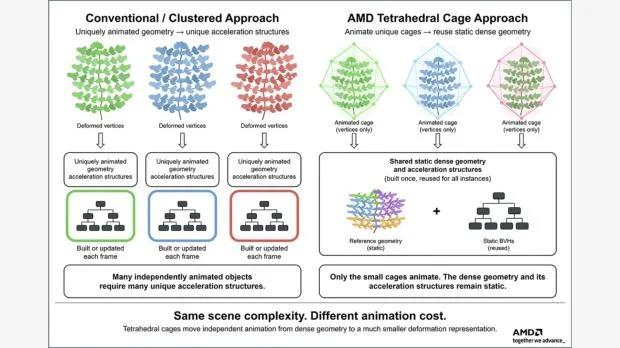
The technical improvements are quantified by AMD as using 47 times less memory and delivering 90 times faster performance in specific metrics. VRAM usage for the scene dropped from 80GB to just 1.7GB during the test. Additionally, the time required for BVH updates per frame fell from 300ms to 3.3ms. The method reduces the number of ray-triangle intersections from 2.8 billion to around 500 million per frame, which directly lowers the processing burden on the GPU.
This technology is compatible with Microsoft DirectX Raytracing, ensuring it can integrate with existing graphics APIs. However, AMD states that the technique is currently in the research phase and not yet available for purchase. The company suggests it could appear with the current RDNA 4 generation, next-generation graphics hardware, or even consoles like the PlayStation 6 at some point in the near future. We touched on BIWIN DW100 DDR5-6000 CL28 Kit Ships in our earlier Amd coverage.
The core takeaway is that AMD is actively developing methods to handle dense, ray-traced environments without crippling performance. While the Radeon RX 9070 XT showcased the potential, the tetrahedral cages method remains a research prototype. Gamers and developers should watch for this technology as it moves toward implementation in future hardware generations.
Source: TweakTown


Discussion
0 comments