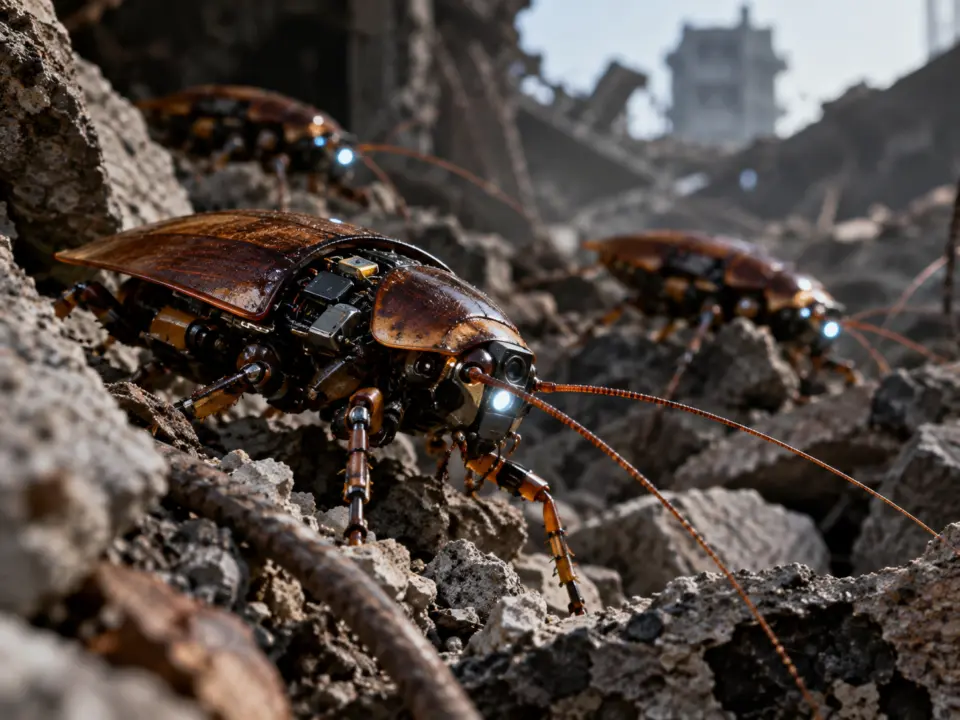
Researchers from the University of Queensland and the University of New South Wales have shifted cyborg insect technology from passive scouting to active medical intervention. This development targets trapped victims in disaster zones where human rescuers cannot safely enter. The team demonstrated that insects can now carry and deploy life-saving equipment rather than just observing environments.
UQ and UNSW researchers demonstrate active medical delivery in disaster zones
The project utilizes North Queensland giant burrowing cockroaches fitted with lightweight electronic backpacks. These devices steer the insects through electrical stimulation while housing specialized tools. The system operates as a duo: one insect carries a camera for visual mapping while a second insect delivers medical supplies via an auto-injector.
Each cyborg cockroach weighs approximately 35 grams and stretches about 8 centimeters in length. The biological component provides mobility while the mechanical load adds precise control capabilities. Researchers tested the injection mechanism's reliability on silicone models and pig tissue to simulate human tissue resistance.
Proof-of-concept trials recorded a 95 percent success rate for injections attempted within 15 centimeters of a target. The full mission sequence, including navigation and delivery, succeeded in 72 percent of attempts. The injection mechanism itself functioned correctly in 90 percent of the trials. These figures indicate the hardware works reliably even if the biological navigation requires refinement.
The researchers stated they have moved cyborg insects beyond simple reconnaissance and into active rescue work. Critics note the unsettling image of an insect delivering medical care may be a hurdle to public acceptance. Current tests rely on animal tissue models, so real-world reliability on human subjects remains unproven. The long-term goal involves a swarm of specialized cyborg insects for sensing and medical delivery.
Source: NotebookCheck


Discussion
0 comments