RayNeo has launched the V4 AI glasses with a focus on speed and battery life rather than adding new features. The company says that the AI glasses industry added over 200 new features in the past year, yet long-term user adoption of those features sits below 6%. RayNeo’s response was to stop adding things and start fixing what already exists.
The RayNeo V4 introduces a dual-chip architecture that cuts wake time to 0.2 seconds while boosting battery capacity by 57 percent over the previous generation.
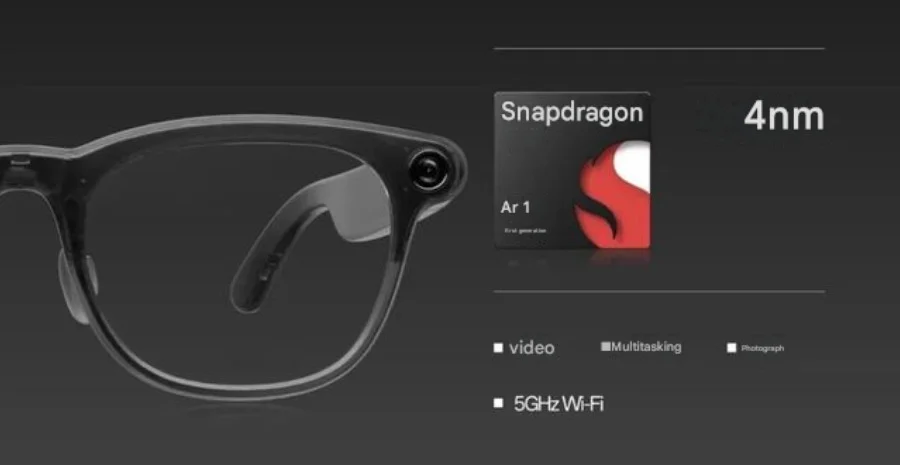
The V4 runs a dual-chip architecture pairing Qualcomm’s Snapdragon AR1 with a Hengxuan BES2800 low-power chip. This setup enables faster wake times and voice responses compared to the previous model. The glasses also include a 4-microphone array plus a bone conduction microphone for improved audio capture.
Specifications
- Processor: Qualcomm Snapdragon AR1 + Hengxuan BES2800 low-power chip
- Wake time: 0.2 seconds
- Voice response time: 2.1 seconds
- Image recognition time: 3.7 seconds
- Microphones: 4-microphone array + bone conduction microphone
The V4 uses a custom Omnivision OG09B square sensor with a 1:1 aspect ratio measuring 1/2.9 inches. Individual pixel size comes in at 2.09 micrometers, and the system supports an F2.2 aperture. It captures 2.5K video through a 17mm ultra-wide lens.
The V4 weighs 38 grams with titanium hinges and carries an IP67 rating for dust and water resistance. The battery capacity increases by 57% over the V3, supporting roughly 47 minutes of continuous video recording or 11.5 hours of music playback. Users can take about 949 photos before hitting 10% battery.
The charging case adds another seven full charges and fast charging gets the glasses to 80% in 25 minutes. The RayNeo V4 starts at 2,199 yuan (around $325) in China. The sunglasses version runs 2,399 yuan (around $353), while the all-in-one set with charging case and accessories is 2,799 yuan (around $412).
First deliveries go out on May 30th for the Chinese market. It’s arriving via OTA update in June for global software support. The company says that long-term user adoption of AI glasses features sits below 6% despite over 200 new features added in the past year.
Source: GIZMOCHINA