Xiaomi has introduced the AI Cube, a prototype mini-PC designed to run large language models directly on local hardware. This development matters because it demonstrates a path toward high-capacity AI inference without relying on cloud servers. Users interested in private data handling or offline AI workflows can now see a concrete example of what such a device looks like in practice.
Prototype mini-PC uses three proprietary chips for local LLM deployment
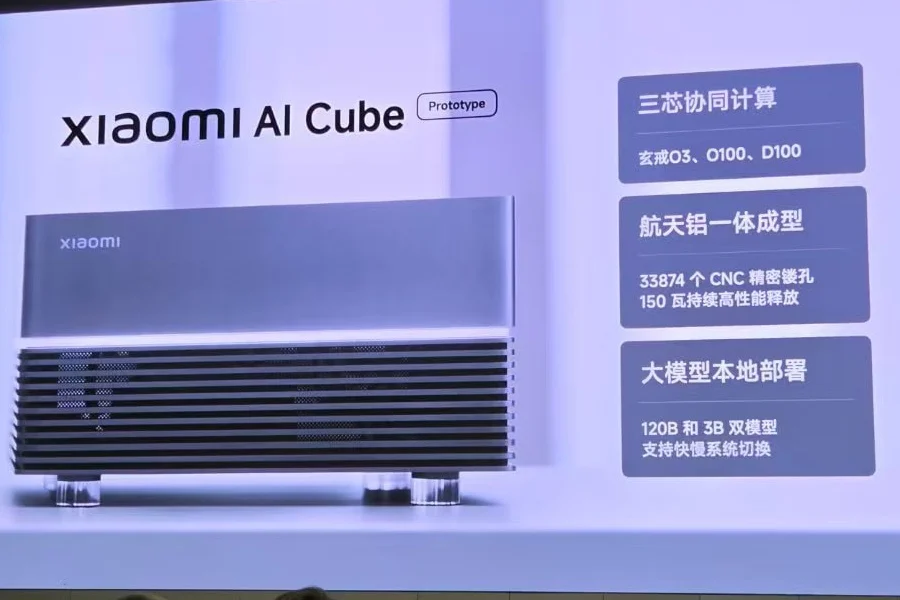
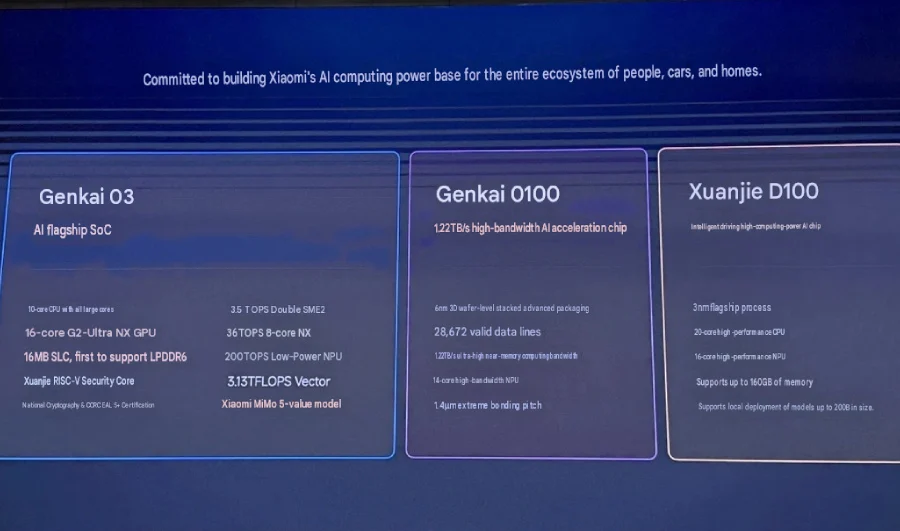
The device serves as a technical demonstration of Xiaomi's internal silicon strategy. It houses three proprietary chips developed by the company. The main processor is the XRING O3, which acts as the central AI system on a chip. Two other chips handle acceleration and specialized driving tasks respectively.
Specifications
- AI SoC: XRING O3 (10-core CPU, 16-core G2-Ultra NX GPU, 200 TOPS NPU)
- AI Acceleration Chip: XRING O100 (6nm 3D wafer-level stacking, 1.22TB/s near-memory computing bandwidth)
- Intelligent Driving Chip: XRING D100 (3nm, 20-core CPU, 16-core NPU, up to 160GB memory support)
- Form Factor: Mini-PC prototype, aerospace-grade aluminum unibody, 150W continuous power
- Model Support: Local deployment of LLMs from 3B to 120B parameters
The XRING O3 features a 10-core all-big-core CPU layout and a 16-core G2-Ultra NX GPU. It also includes a 200 TOPS low-power NPU for efficient neural network processing. The XRING O100 acceleration chip uses 6nm 3D wafer-level stacking to achieve 1.22TB/s near-memory computing bandwidth. The XRING D100 driving chip supports up to 160GB of memory with a 20-core CPU and 16-core NPU.
The hardware enclosure is an aerospace-grade aluminum unibody with 33,874 CNC precision cutouts. It can sustain up to 150W of continuous power output. The system supports the local deployment of large language models ranging from 3B to 120B parameters. This range allows it to handle both lightweight and massive AI workloads on a single machine.
Xiaomi has not announced a commercial release date or pricing for the AI Cube. The company stated that the device is currently a prototype. It remains unclear whether this hardware will become a consumer product or stay as a technical demonstration. We have been tracking Xiaomi AI Cube closely — see our earlier coverage on Xiaomi Mix Fold Next Gen to.
The AI Cube confirms Xiaomi's capability to build custom silicon for high-performance AI tasks. The prototype showcases specific architectural choices like 3D stacking and high-bandwidth memory interfaces. Buyers should watch for official announcements if Xiaomi decides to commercialize this platform.
Source: Xiaomi, GIZMOCHINA