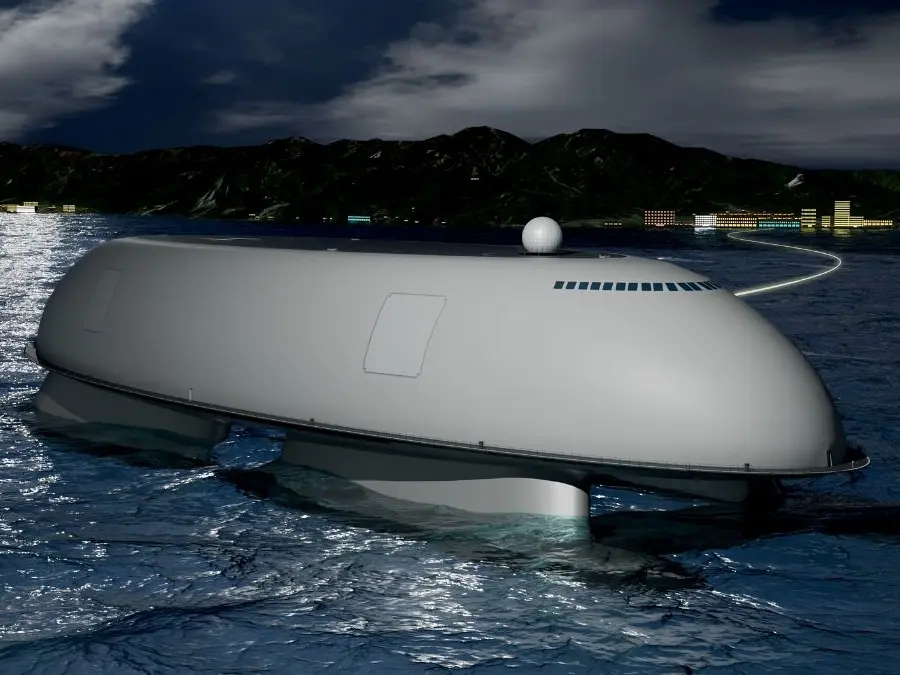
Optimal Transit has introduced the Kraaken, a floating platform that generates electricity, fresh water, and AI compute power without relying on land-based infrastructure or fossil fuels. This design offers coastal communities a way to access critical resources while remaining mobile enough to evacuate before severe weather strikes. The vessel addresses the growing demand for sustainable AI infrastructure by decoupling high-power data centers from the grid and local water supplies.
The 90-meter vessel generates power, water, and AI compute without land infrastructure
The flagship model, known as the VITAL 100 MW Kraaken, sits on a small waterplane area twin hull (SWATH) design that measures roughly 90 meters in length. It utilizes a proprietary Digital Ocean Thermal (DOT) system to harness energy from ocean heat differentials. This architecture allows the vessel to operate entirely off-grid, delivering power and water directly to shore via umbilical connections that can be quickly disconnected.
Kraaken Specifications
- Power Generation Capacity: 100 MW
- AI Compute Capacity: 60 MW
- Water Production: 8 million gallons daily
- Homes Powered: 32,000
- People Served by Water: 150,000
The 100 MW configuration is designed to provide clean electricity for approximately 32,000 homes while producing nearly 8 million gallons of desalinated water daily for about 150,000 people. A significant portion of this capacity, specifically 60 MW, is dedicated to AI compute workloads. The system integrates computing waste heat into the thermal cycle, improving overall energy efficiency compared to traditional land-based data centers.
Building the vessel costs less than $500 million, which is substantially lower than the $750 million to $1.33 billion required for equivalent land-based facilities. Annual operating expenses are projected to fall between $10 million and $20 million. While the company is currently developing engineering designs and awaiting additional financing for production, the scalable nature of the platform allows for configurations ranging from 10 MW to 100 MW.
The Kraaken represents a shift toward mobile, zero-emission infrastructure that can respond to disaster scenarios by relocating within hours. It offers a tangible alternative to fixed coastal data centers by combining power generation, water production, and high-density computing in a single floating unit. The project moves from concept to engineering design as Optimal Transit seeks to secure the necessary capital for manufacturing.
Source: NotebookCheck