MediaTek is preparing to launch its next-generation Dimensity 9500 smartphone chipset in September 2025. The chip targets flagship mobile devices and aims to compete directly with Samsung's upcoming Exynos 2600 processor.
MediaTek prepares to launch its next-generation Dimensity 9500 smartphone chipset in September 2025, targeting flagship mobile devices and aiming to compete directly with Samsung's upcoming Exynos 2600 processor.
The Dimensity 9500 uses a TSMC 3nm manufacturing process for improved power efficiency and performance density. It features an eight-core CPU configuration split into three clusters: one high-performance core clocked at 4.21 GHz, three premium cores at 3.5 GHz, and four efficiency cores running at 2.7 GHz.
Spec comparison
| Spec | Dimensity 9500 | Exynos 2600 |
|---|---|---|
| Process node | TSMC 3nm | Samsung 2nm |
| CPU cores | 8-core (1×4.21GHz + 3×3.5GHz + 4×2.7GHz) | 10-core all-big (1×3.8GHz + 9×2.75GHz) |
| GPU | Immortalis Mali-G1 Ultra MP12 | Xclipse 960 |
| Connectivity | Integrated 5G modem, Wi-Fi 7, Bluetooth 6.0 | External modem, Wi-Fi 7, Bluetooth 6.0 |
Graphics processing relies on the Immortalis Mali-G1 Ultra GPU with twelve execution units and native ray tracing support. MediaTek includes its HyperEngine Gaming Technology to optimize frame rates and thermal management during intensive mobile gaming sessions.
The chipset supports LPDDR5X memory operating at speeds up to 5.3 GHz and UFS 4.1 storage for fast data access. Camera capabilities include the Imagiq 1190 ISP handling single sensors up to 320 megapixels with real-time semantic segmentation and 8K video recording.
Connectivity options integrate a 5G modem compliant with 3GPP Release 17 standards delivering download speeds up to 7.4 Gbps. The device also supports Wi-Fi 7 with peak throughput of 7.3 Gbps and Bluetooth 6.0 for wireless peripherals.
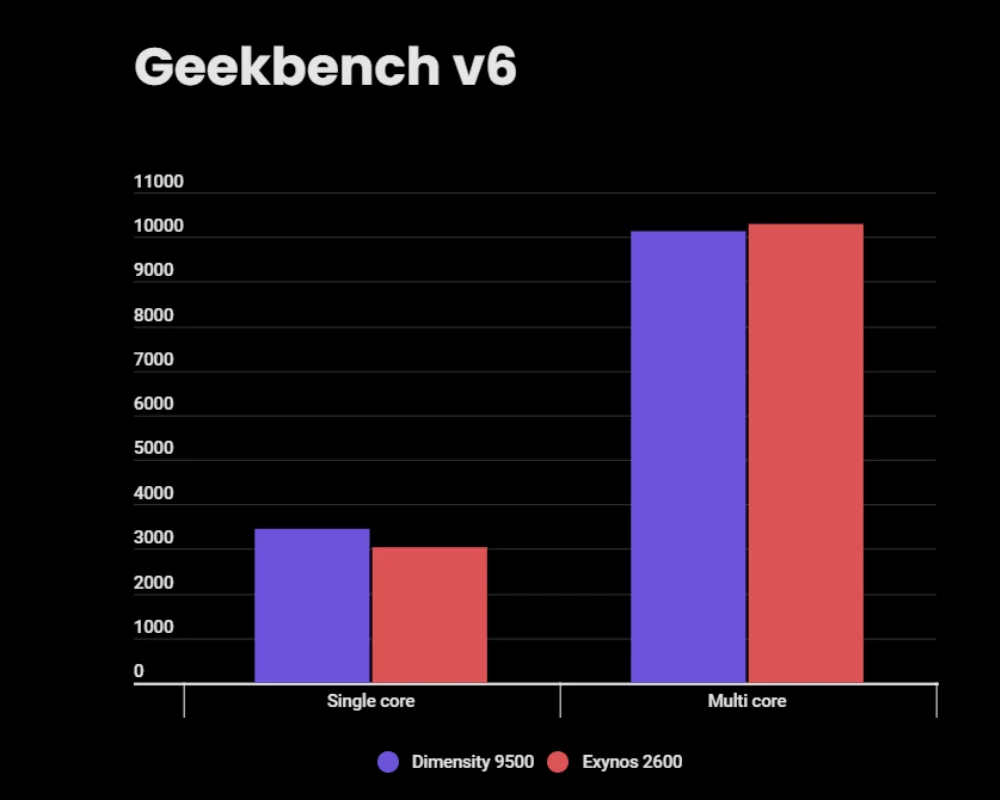
Benchmark data shows the Dimensity 9500 achieves a 13 percent higher single-core score in Geekbench 6 CPU tests compared to previous generations. AnTuTu results place the chip at approximately 3.2 million points while Samsung's Exynos 2600 scores over 3.5 million points total.
The Exynos 2600 utilizes a Samsung 2nm process with a ten-core all-big design featuring one core at 3.8 GHz and nine cores at 2.75 GHz. It pairs an Xclipse 960 GPU with an external modem capable of up to 14.79 Gbps download speeds versus the Dimensity's integrated solution.
Both processors support Wi-Fi 7, Bluetooth 6.0, UFS 4.1 storage, and LPDDR5X memory configurations. The Exynos 2600 leads in multi-core Geekbench performance and CPU sub-scores within AnTuTu benchmarks while maintaining higher overall connectivity throughput.
Source: GIZMOCHINA