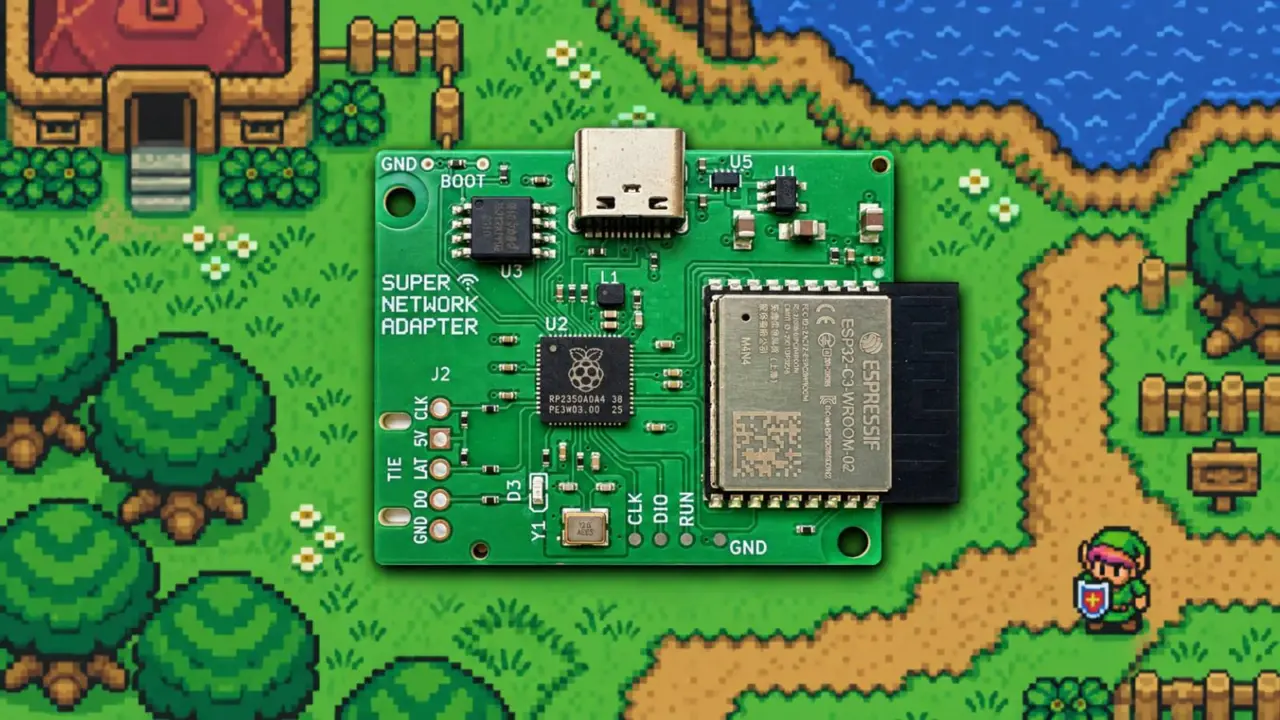
Retro gaming hardware tends to focus on nostalgia, but one new accessory is trying to fill in that gap with some modern functionality. Introducing the Super Network Adapter (SNET) which gives the Super Nintendo Entertainment System (SNES) wireless capabilities. This is important because the SNET offers ways to synchronize game saves and patch games without the need to open the cartridge. You can turn a static 16-bit peripheral into one that can work with your local network and even some AI.
DIY accessory brings wireless networking and AI dialogue to 16-bit console
The SNET, which is a creation from DIYer Danny Boland, is an authentic SNES peripheral for your original hardware. This device connects directly into your SNES controller port so it won't take up any more space for your console. According to Boland, this is all part of "16-bit futurism." His vision is for the future retro gamers thought about back then. That includes wireless connections and being able to use stuff cross-device.
- Microcontrollers: RP2350 and ESP32-C3
- Interface: SNES controller port
- Data Transfer Speed: around 30 KB/s
- Connectivity: Wi-Fi
The SNET is made up of a couple of microcontrollers that take care of business. There's an RP2350 paired up with an ESP32-C3. The former is used for the processing while the latter is for wireless capabilities.
All told, the system offers about 30 KB/s data transfer rates over the SNES controller port. There's Wi-Fi support for connecting to your local network or it can work as an access point.
SNET gives you some neat abilities for your SNES setup. With this device, you can patch ROMs and sync game saves between cartridge and server. You can even use AI to have some non-player character dialogue. This means you can have some of these modern interactions with old-school games without changing anything about your hardware.
The Super Network Adapter is a pretty useful addition to the SNES world. You're getting some wireless network support as well as some artificial intelligence with this device. All of this added to a gaming console that came out in the 1990s. It shows how retro hardware can grow to meet modern digital expectations.
Source: IXBT
30 KB/s is painfully slow. The SNES controller port was never built for high throughput. This feels like a novelty project.