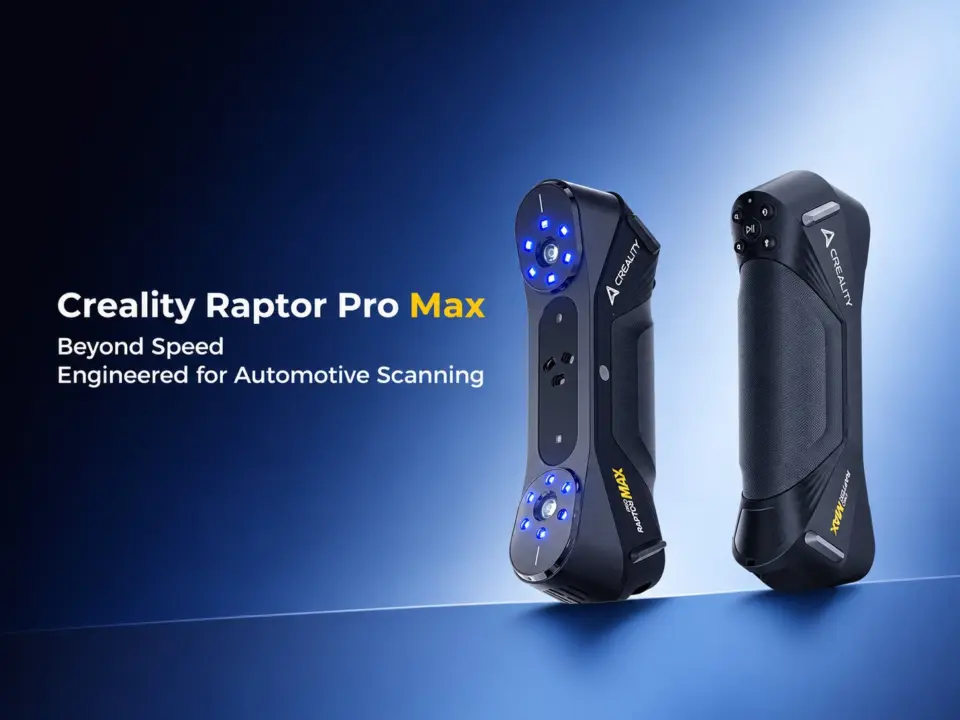
Creality has upgraded its Raptor Pro Max handheld 3D scanner to effectively scan larger automotive parts and handle intricate reverse engineering workflows. The new version captures far more data points in each scan, significantly speeding up the scanning process for medium to large-sized objects such as car bodies or industrial components. This update is significant for users looking to scan medium and large-sized objects in a single scan, instead of stitching together a bunch of individual frames.
Creality upgrades scanner with 42 laser lines and 1.26 million points per second speed
The Raptor Pro Max is aimed at professionals involved in automotive customizations and reverse engineering, with the ability to scan objects in the 5-4,000 mm range. Weighing in at 400 g, the handheld device is lightweight enough for longer scanning sessions on intricate projects. The scanner's optimal working distance is set at 550 mm, so users don't have to get too close to their scan objects.
Specifications
- Laser Lines: 42 crossed blue laser lines
- Scanning Rate: 1.26 million points per second
- Capture Area: 480 x 330 mm
- Working Distance: 550 mm
- Weight: 400 g
Under the hood, Creality boosted the number of crossed blue laser lines from 22 to 42. This hardware update enables the scanner's maximum scanning rate to reach 1.26 million points per second—almost double that of its predecessor. Plus, the area of a single captured frame has grown by up to 40%.
Now, it can cover 480 x 330 mm at the standard working distance. Volumetric accuracy remains at 0.02 mm + 0.08 mm/m, ensuring precise measurements.
Creality has released the Raptor Pro Max to the international market starting November 19, 2023. The introductory price in the US is $1,619, with a suggested retail price of $1,799. Please note that these specs are based on lab conditions, so actual performance in a bustling auto workshop environment might differ slightly from the stated accuracy claims.
The Raptor Pro Max adds to Creality's roster as a high-speed scanner for large-format objects. It represents a substantial upgrade in speed and coverage area compared to previous versions. For those in search of a dedicated solution for digitizing large-sized parts, this upgraded hardware is now available at the new price point.
Source: NotebookCheck

Doubling the point cloud density to 1.26 million per second is a massive jump from the 660k baseline. The 42 laser lines will definitely reduce stitching errors on complex automotive curves.
Is the 1619 dollar price tag sustainable for individual reverse engineers or is this strictly for fleet buyers in auto shops? The volumetric accuracy specs look tight but the entry cost is steep.