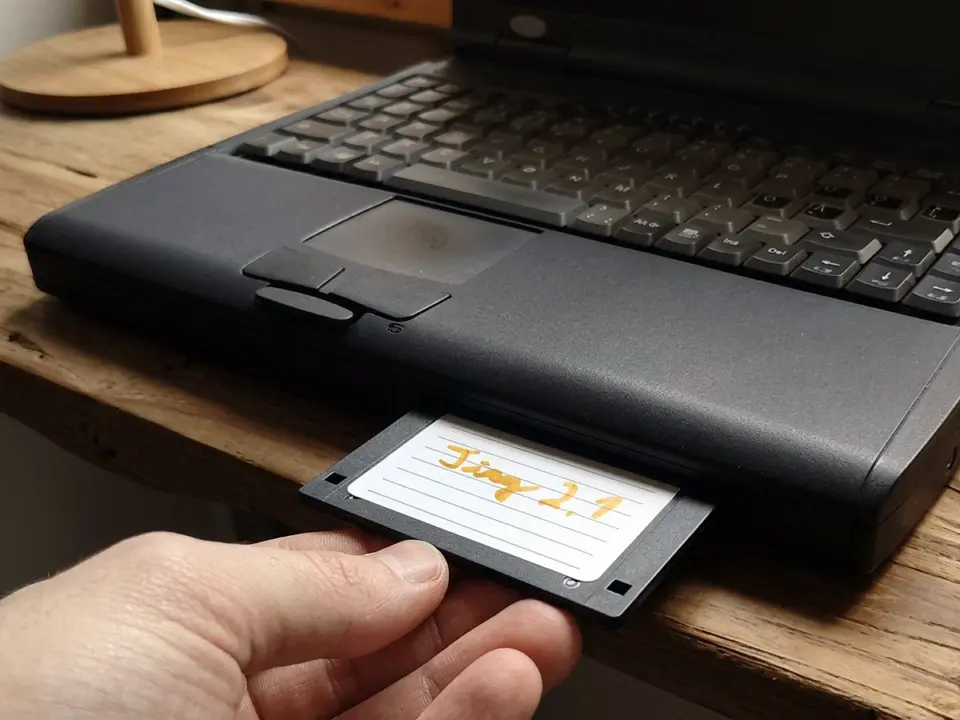
A developer has released a miniature AI chatbot that runs on MS-DOS, targeting users who want to experiment with vintage 486DX and Pentium-class machines. This release matters because it proves that even a tiny neural network can function on hardware that predates modern operating systems, offering a unique way to test AI constraints on legacy systems. The model fits entirely on a single 1.44 MB floppy disk, which challenges the assumption that AI requires massive storage and processing power.
WollyMonjac releases 367,000-parameter model for vintage 486DX and Pentium PCs
The project, named Tiny 2.1, is a software release by WollyMonjac that brings a 367,000-parameter language model to the MS-DOS environment. It uses a compact 4-layer network with a hidden dimension of 96, allowing it to operate within the severe memory limitations of early personal computers. The model targets 486DX and Pentium-class machines, making it accessible to owners of retro hardware who want to run inference without modern virtualization overhead.
Tiny 2.1 relies on weights stored as 8-bit integers to keep its footprint small, resulting in a weight file size of just about 380 KB. The program requires roughly 540 KB of free conventional memory to run, and with the program included, the total size sits at about 435 KB. This extreme efficiency allows the entire model to fit on a single 1.44 MB floppy disk, a storage medium that was standard in the 1990s but is now largely obsolete.
The model was written by Claude and trained by Opus 5.5, according to the developer, though these model names appear to be internal or fictional references. It handles simple Q&A and math tasks well when the questions involve words and facts it is trained on, but it hallucinates on complex or overly long questions. WollyMonjac released the source code as open-source software on GitHub under the MIT license, allowing anyone to download the ZIP file and run the model on real hardware or an emulator.
Tiny 2.1 demonstrates that basic AI inference is possible on hardware with less than 1 MB of RAM, provided the model architecture is extremely small. Users can download the code from GitHub and run it on a 486DX or Pentium machine to see how a 367,000-parameter model performs on vintage MS-DOS systems. The project highlights the technical constraints of early computing while showing that AI does not always require modern infrastructure to function.
Source: NotebookCheck

Fits on a floppy. That is the only metric that matters. The rest is noise.