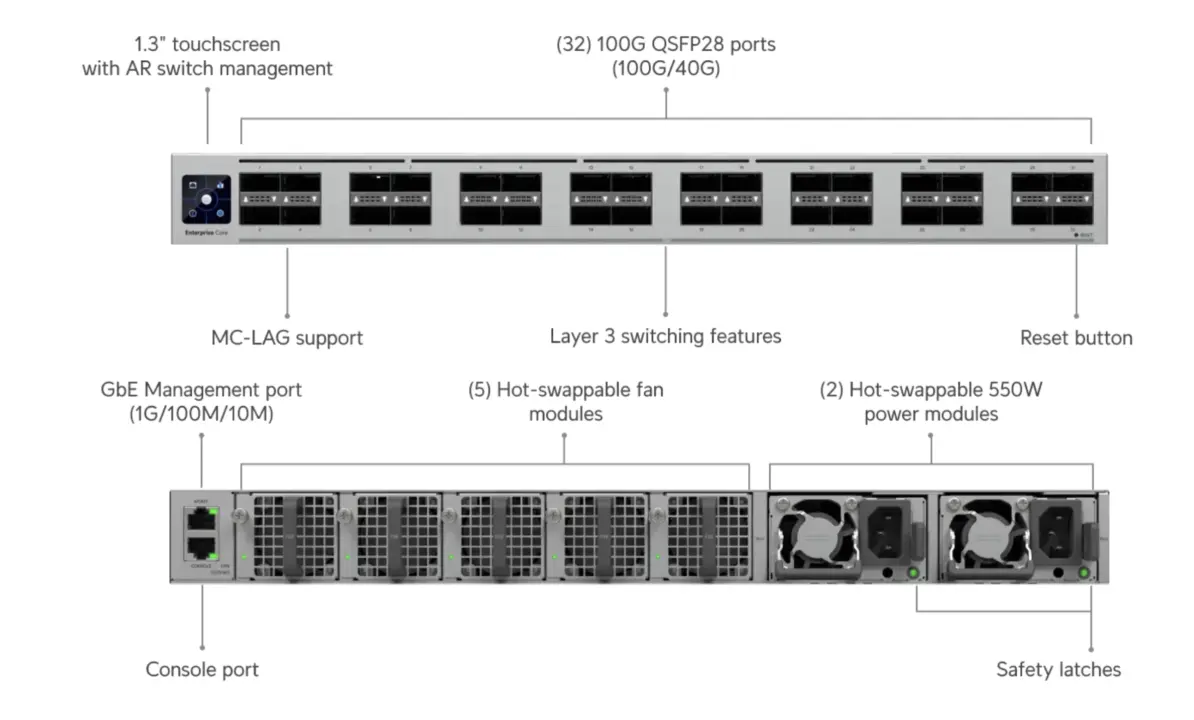
Ubiquiti has entered the enterprise core switching market with a new high-density platform designed for large-scale campus deployments. This move targets network administrators who need to aggregate massive amounts of traffic without creating bottlenecks at the distribution layer. The new hardware aims to simplify complex Layer 3 routing tasks while providing the redundancy required for critical infrastructure.
New hardware targets campus aggregation with MC-LAG redundancy
The flagship model, identified as the ECS-Core, features 32 QSFP28 ports to handle high-speed uplinks and server connections. It delivers a total non-blocking throughput of 3.2 Tbit/s and a switching capacity of 6.4 Tbits/s. A lower-tier variant is also available for smaller deployments, utilizing SFP28 ports to provide 1.8 Tbit/s of throughput.
Spec comparison
| Spec | SFP28 Model | QSFP28 Model |
|---|---|---|
| Throughput | 1.8 Tbit/s | 3.2 Tbit/s |
| Switching Capacity | N/A | 6.4 Tbits/s |
| Port Configuration | SFP28 | 32 QSFP28 |
| Price (US) | $4,314 | $5,393 |
Both versions fit into a standard 1U 19-inch rack space but require full depth installation. The switch supports up to 1,000 VLANs and maintains a MAC address table for 128,000 entries. To ensure continuous operation, the chassis includes two hot-swappable power supply units and five hot-swappable fans for redundancy.
The hardware supports MC-LAG, which allows for multi-chassis redundancy and load balancing across multiple devices. This feature helps network engineers maintain uptime during hardware failures or maintenance windows. The system is positioned as a robust aggregation point for modern enterprise networks requiring high availability.
The SFP28 version is priced at 4,314 USD for the US market. The higher-performance QSFP28 model costs 5,393 USD. The listed prices cover the hardware only and exclude optional software licenses or support contracts.
Source: Ubiquiti, NotebookCheck


Discussion
0 comments