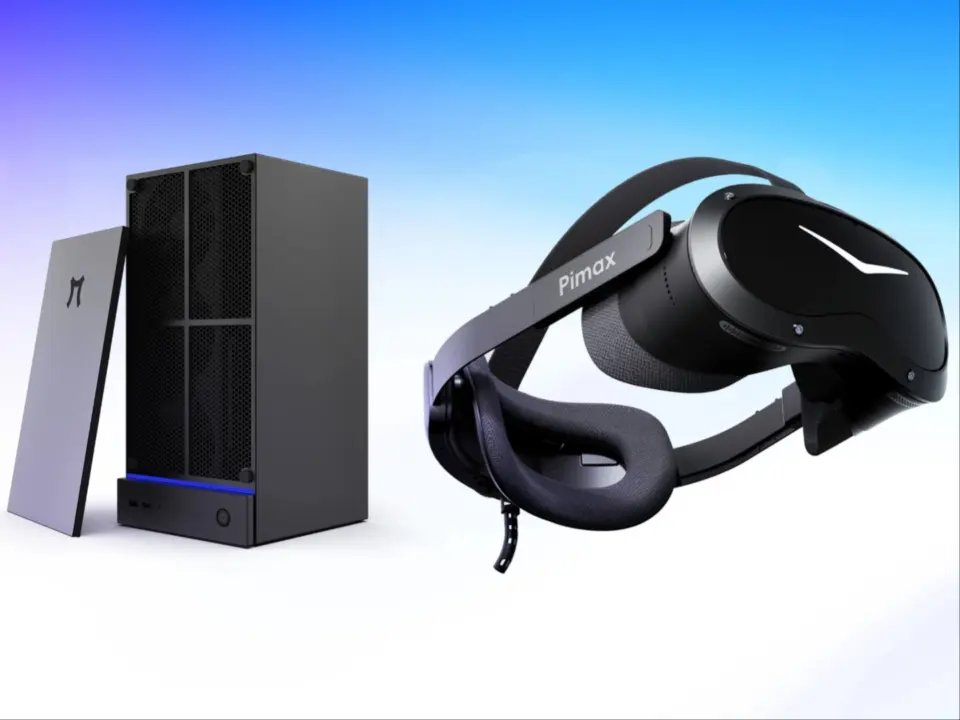
Pimax is introducing a new high-end VR ecosystem that pairs a standalone headset with a powerful mini-PC to challenge Valve's Steam Frame and Steam Machine. This approach targets users who want console-like simplicity without sacrificing the raw graphical power of a desktop gaming rig. Buyers looking for a tethered VR experience that delivers high fidelity should pay close attention to these new specifications.
Pimax introduces a high-end VR ecosystem pairing a standalone headset with a powerful mini-PC to challenge Valve's Steam Frame and Steam Machine
The Pimax Crystal Pro headset serves as the visual interface for the system. It features TFT QD-LCD displays that deliver 2,880×2,880 pixels of resolution per eye. The panel supports up to 120 Hz refresh rates and covers a 110-degree field of view. A Snapdragon XR2 Gen1 chip handles the standalone processing, while a 16,000 mAh external battery pack provides power.
Spec comparison
| Spec | Crystal Pro | Spation Mini-PC |
|---|---|---|
| Resolution | 2,880×2,880 per eye | N/A |
| Refresh Rate | Up to 120 Hz | N/A |
| Processor | Snapdragon XR2 Gen1 | Ryzen 7 9800X3D |
| GPU | Integrated | Radeon RX 9070 XT / RTX 5070 Ti |
| Price | $1,399 (headset + battery) | Unannounced |
The companion mini-PC, branded as the Pimax Spation, houses the heavy computational load. It is equipped with a Ryzen 7 9800X3D CPU and a choice of either a Radeon RX 9070 XT or an RTX 5070 Ti GPU. The system includes 32 GB of DDR5 RAM and a 1 TB M.2 NVMe SSD. A 1,000W SFX power supply ensures the components remain stable during intensive gaming sessions.
Pimax claims the Spation mini-PC delivers significantly higher raw performance than the Steam Machine. The Crystal Pro headset is priced at $1,399 for the unit and battery alone. A bundle that includes the 60G AirLink costs $1,899. Shipping for the Crystal Pro is scheduled to begin in 2027.
Pricing for the Spation mini-PC has not been revealed yet. The exact dimensions of the mini-PC have also not been shared by the vendor. These details will likely become available closer to the product's launch window.
Source: Pimax, NotebookCheck



Discussion
0 comments