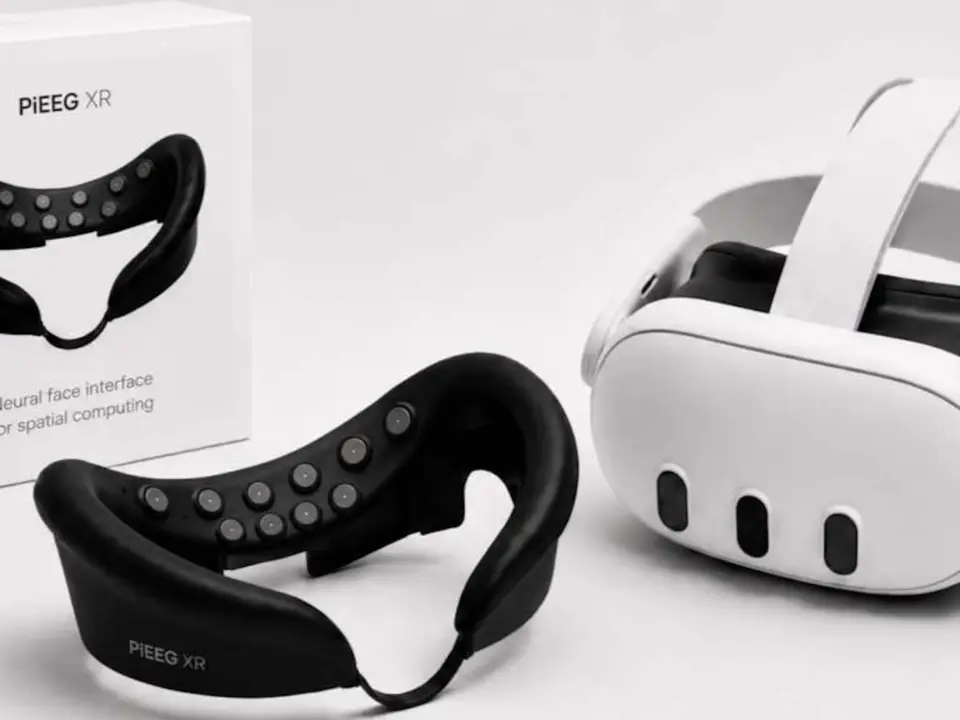
The PiEEG XR is a neural face interface designed for virtual reality and extended reality headsets, functioning as an EEG system to measure brain activity in real time. It replaces the standard face cushion of VR headsets with a mask that contains built-in electrodes to capture electrical signals from the user's forehead. This hardware approach allows researchers, makers, and consumers to interact with virtual environments using neural data without requiring invasive procedures or bulky external equipment.
ironbci introduces a wireless EEG add-on that replaces standard face cushions to capture real-time brain signals
The device is developed by ironbci and operates as an add-on peripheral for existing VR hardware rather than a standalone headset. It connects wirelessly via Bluetooth to compatible devices, such as the Pico 4 Ultra, ensuring stable data transmission during use. The device features a lightweight design intended for prolonged comfort, replacing the traditional face cushion with integrated electrodes that preserve standard ergonomics.
Technical specifications center on high temporal resolution, with ironbci stating that the PiEEG XR can record 250 data points per second. This sampling rate is intended to provide precise tracking of neural activity for real-time applications in gaming and research environments. Data is processed at 250 points per second locally and transmitted via Bluetooth to ensure high temporal resolution for wireless VR headsets.
The product will be available through multiple configurations depending on the target audience. Users can purchase the PiEEG XR Mask alone, a research kit that includes additional development tools from ironbci, or an all-in-one consumer version tailored for general use. APIs and SDKs are planned to allow developers to integrate the neural data into custom applications across various platforms.
Native compatibility with VRChat is advertised as a key feature of the launch, though this functionality has not yet been verified by independent testing. The interface offers a novel input method for VR environments, potentially supplementing or replacing standard controller usage in social applications. The Kickstarter campaign targets makers, researchers, and consumers for early testing of the neural interface capabilities.
The PiEEG XR will be funded through a Kickstarter campaign, positioning it as an accessible hardware prototype rather than a mass-market consumer product at launch. The project is backed by Ildar Rakhmatulin, a recognized expert in neural interfaces who has previously attempted to bring similar technology to market. Funding through a Kickstarter campaign enables the developers to verify market interest and finalize production designs prior to mass manufacturing.
Source: For VR, NotebookCheck