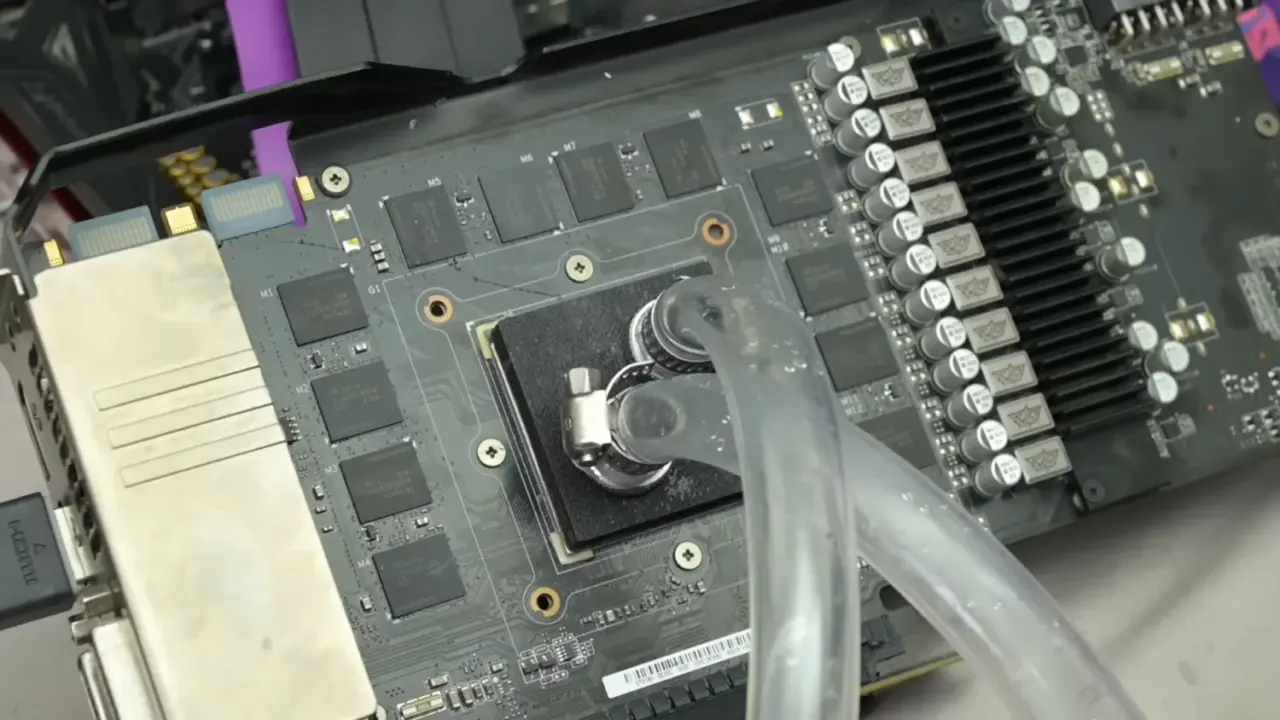
Custom cooling experiments on the NVIDIA RTX 2060 Super reveal that direct water-on-die contact can drastically lower thermal limits compared to standard cooling methods. This matters to enthusiasts who push hardware beyond stock specifications, as it demonstrates the physical limits of GPU thermal management when bypassing traditional heat spreaders. We often look for ways to squeeze more performance out of existing parts, and extreme cooling techniques offer a clear path to lower temperatures under heavy loads.
Custom cooling experiment reveals extreme thermal potential for GPU enthusiasts
TrashBench conducted a series of thermal benchmarks comparing three distinct cooling configurations on the RTX 2060 Super GPU. The experiment tested stock air cooling, an all-in-one (AIO) liquid cooler, and a custom direct water block that contacts the GPU die directly without a heat spreader. The setup required significant modification, using 3D printed parts, adhesive, and nail polish to seal the components and prevent electrical short circuits or leaks during the water cooling process.
The direct water-on-die cooling method achieved a temperature of 28C during Unigine Heaven benchmarking, which significantly outperformed the AIO cooler's 36C and the stock cooling result of 70C. When the custom water loop was further chilled using a freezer, the GPU temperature dropped even lower to 13C. These results confirm that removing the heat spreader allows for more efficient heat transfer from the die to the coolant.

The experiment also included testing on an Intel Core i5-7600K CPU to see if the direct water method would yield similar results on a processor. In Cinebench R23 tests, the AIO cooler achieved 39C, while the direct water setup only reached 52C, indicating that the technique is less effective for this specific CPU architecture. TrashBench noted that benchmarks show direct water on die cooling with no heat spreader outperforms AIO liquid cooling on a GPU, but the results vary by component design.
It remains unclear if this type of cooling solution will ever be seen in a retail product due to the complexity and risks involved in the modifications. The experiment highlights the thermal potential of direct die cooling for GPUs while also showing its limitations when applied to CPUs like the i5-7600K. Enthusiasts interested in extreme cooling should note that these results come from a highly specialized, non-standard setup rather than a mass-produced solution.
Source: TweakTown