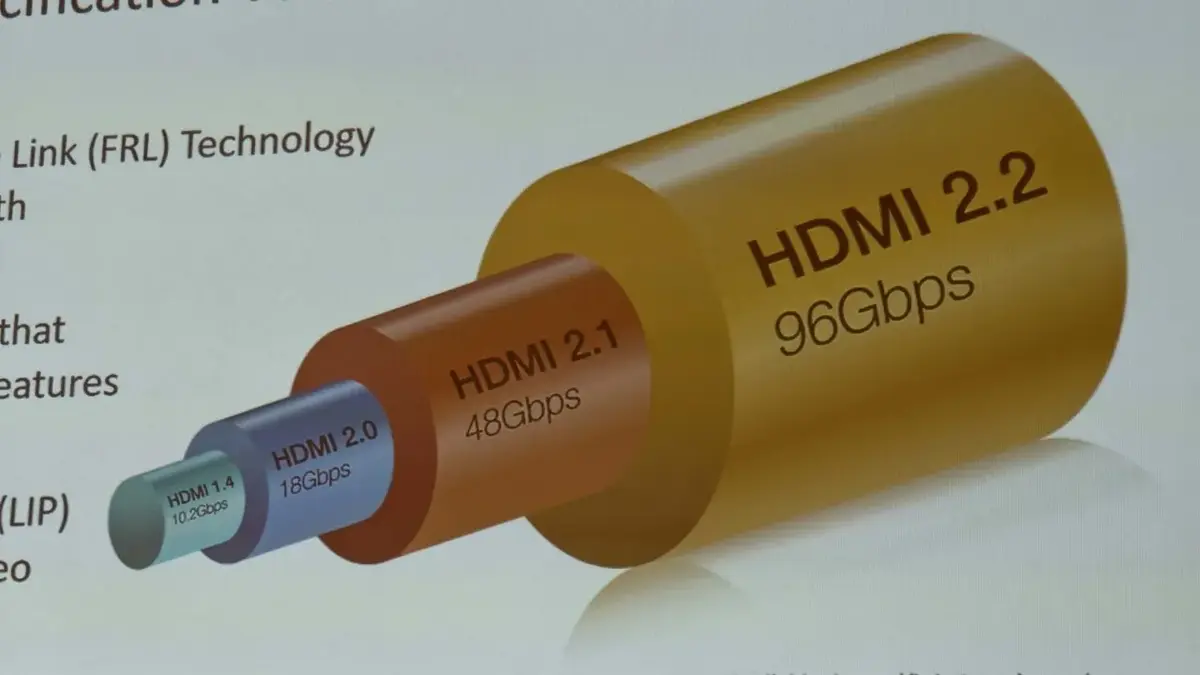
HDMI Licensing Administrator finalized the HDMI 2.2 specification in June 2025, establishing a new standard for high-bandwidth video transmission. The update doubles the maximum data rate to 96 Gbps, which allows manufacturers to push display resolutions and refresh rates far beyond current limits without compression artifacts.
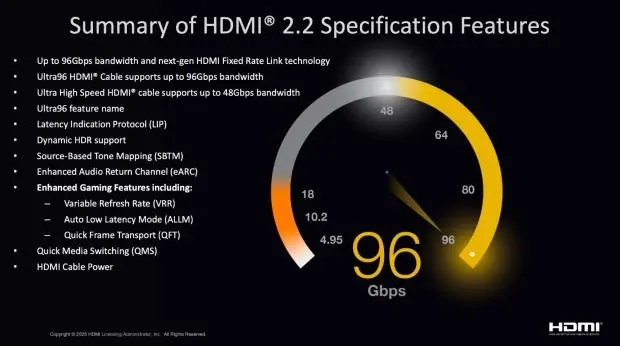
Chip makers begin sampling FRL2 silicon this year for next year products
The core of this upgrade is the introduction of FRL2, or Fixed Rate Link 2, technology. Chip manufacturers are expected to begin sampling FRL2 silicon this year, according to Rob Tobias, the CEO and president of HDMI Licensing Administrator. This sampling phase marks the transition from specification definition to physical hardware development.
HDMI 2.2 supports uncompressed 4K video at 240Hz, 8K at 60Hz, 12K at 120Hz, and 16K at 60Hz. The standard also introduces LIP, or Latency Indication Protocol, to help manage signal timing more effectively. These capabilities rely on the increased 96 Gbps bandwidth to deliver genuine visual fidelity without relying on Display Stream Compression.
The HDMI Forum confirmed that the Ultra96 branding will cover devices operating at 64 Gbps, 80 Gbps, or 96 Gbps. A leak suggests that initial RDNA 5 GPU support may be limited to the 64 Gbps and 80 Gbps tiers rather than the full 96 Gbps. With Display Stream Compression enabled, the standard theoretically supports 1440p resolution at over 1,000Hz.
First HDMI 2.2 products are on track for release in 2027. Next-generation consoles, including the PS6 and Project Helix, are expected to support the new standard alongside RDNA 5 graphics cards. The timeline reflects the time needed for chip sampling and subsequent product integration.
We looked at previous HDMI specification updates while tracking the evolution of display bandwidth standards. The HDMI 2.2 rollout represents a significant step in high-resolution video connectivity.
HDMI 2.2 establishes a 96 Gbps baseline with FRL2 silicon sampling starting this year. Products utilizing the new standard will likely appear in 2027 with support for uncompressed 8K and 12K video.
Source: TweakTown