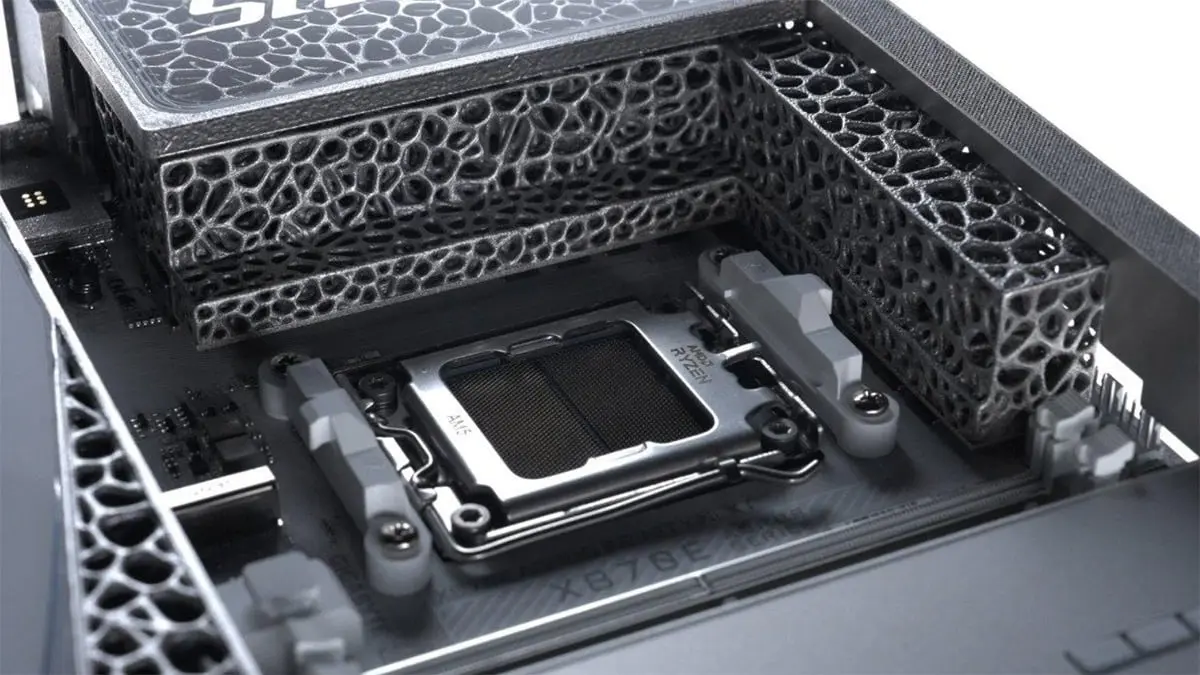
GIGABYTE has teased the X870E AORUS Infinity Next motherboard ahead of Computex 2026, showcasing a design built for extreme overclocking rather than standard consumer use. The motherboard features a 3D-printed honeycomb heatsink made of specialized materials designed for maximum heat dissipation.
GIGABYTE showcases a limited edition motherboard with massive power delivery and custom cooling ahead of Computex 2026
The centerpiece of the Infinity Next is a heatsink constructed from a 3D-printed honeycomb lattice structure. GIGABYTE describes the material used as rocket thruster-grade thermal compound, engineered to maximize heat dissipation efficiency. This manufacturing process requires two full days to print each individual board, highlighting the complexity and exclusivity of the component.
- VRM phases: 64-phase VRM capable of delivering over 5000 Amperes of current
- Heatsink material: 3D-printed honeycomb heatsink structure made of 'rocket thruster-grade thermal materials'
- Heatsink production time: Takes two days to print per board
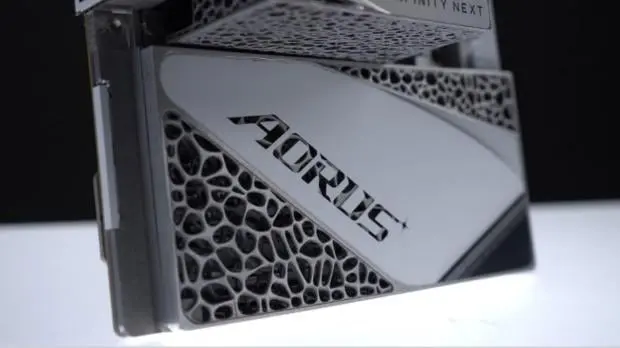
Power delivery for this platform relies on a 64-phase VRM design capable of outputting over 5000 Amperes of current. The 64-phase VRM is capable of delivering over 5000 Amperes of current to handle demanding processing tasks. Dual RAM slots are included to emphasize heavy overclocking capabilities, drawing inspiration from previous AORUS Tachyon designs.
GIGABYTE has not released full technical specifications for the Infinity Next beyond these core components. The company emphasized that this is a limited edition product expected to cost well into the four figures. Full pricing has not been disclosed, but the board is expected to cost thousands of dollars due to its complex manufacturing process.
Whether the X870E AORUS Infinity Next will reach retail shelves remains uncertain. GIGABYTE has indicated that the board might serve primarily as a proof of concept to demonstrate engineering capabilities. Whether this board reaches store shelves remains uncertain, as it may serve primarily as a proof of concept for future technologies.
The X870E AORUS Infinity Next was teased by GIGABYTE ahead of Computex 2026 as an extreme consumer platform. Previous AORUS Tachyon models focused on similar high-performance niches, but this iteration pushes boundaries further with its custom heatsink and massive VRM setup. GIGABYTE showcased this motherboard at its pre-Computex 2026 press conference to demonstrate advanced hardware engineering.
Source: TweakTown