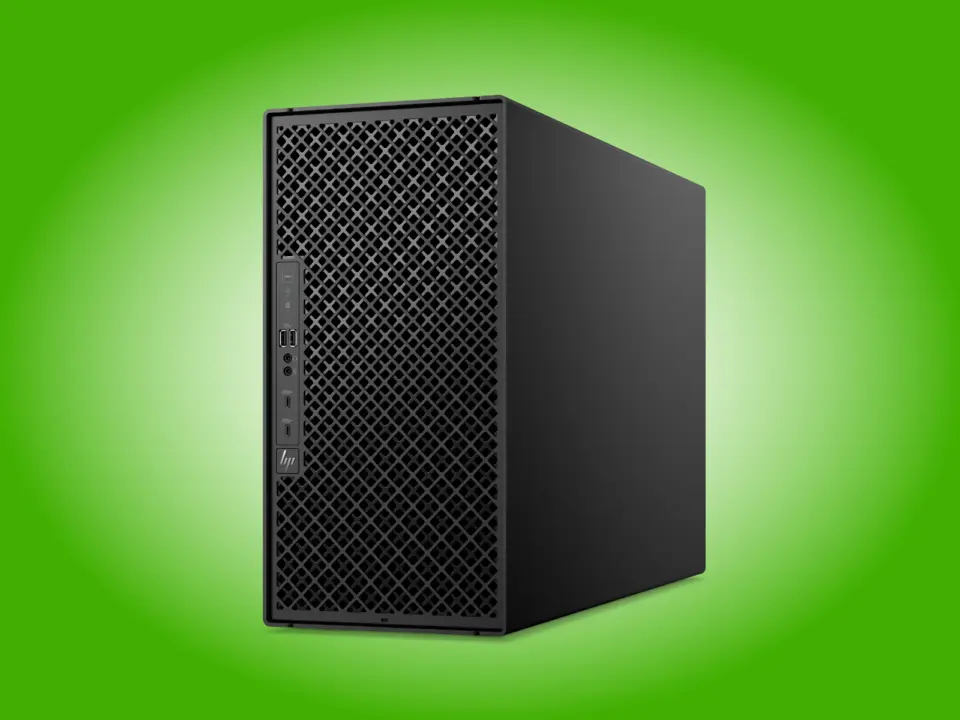
HP just started selling the ZGX Fury AI Station in the United States. And it's the beginning of a whole new world in high-end workstation computing. Finally, we have a system that's 100% based around the latest Nvidia GB300 architecture.
HP begins US sales of the ZGX Fury AI Station workstation
It gives us a single-stop-shop for all your giant AI stuff. Except, this rig starts at $132,000. So, uh, buckle up for that enterprise level price tag.
Specifications
- Processor: Nvidia GB300 Grace Blackwell Ultra (72 ARM Neoverse V2 cores)
- System Memory: 496 GB LPDDR5x-6400
- VRAM: 252 GB HBM3e (GPU memory)
- Storage: Dual 2 TB SSDs (plus two M.2 slots for up to 32 TB)
- Connectivity: Three PCIe Gen 5 and QSFP112 (400 Gbps) ports
As the name suggests, the centerpiece of this workstation is the Nvidia GB300 Grace Blackwell Ultra chipset, which blends 72 ARM Neoverse V2 cores into a single CPU. This main CPU is augmented by 496 GB of system memory (LPDDR5x-6400) so all that data can fly to the CPU in a hurry. Not to mention 252 GB of HBM3e GPU memory. That has a whopping 7.1 TB/s of bandwidth to crunch all your graphical/computing goodness.
We're also talking big-time data processing and multi-node use cases here. It's equipped with two 2 TB SSDs, but you also get a couple of M.2 slots to add up to 32 TB of storage. You can use three PCIe Gen 5 ports and QSFP112 (400 Gbps) interfaces to hook up two of these bad boys together. No need to just rely on network stuff to talk fast to the other workstation.
If you need more firepower in parallel computation outside the built-in GB300 stuff, there's a couple of discrete GPU options. You can add the RTX Pro 2000 with 16 GB GDDR7 VRAM for $1,000 (now it's $133,000 total) or the RTX Pro 4000 with 24 GB GDDR7 VRAM for $4,000 ($136,000 total). That's some extra memory for your extra complex rendering or inference stuff that can't fit on the GPU anymore.
Source: NotebookCheck
$132,000 for a desktop. I need to sell a kidney just to look at the specs, tbh.
The 7.1 TB/s bandwidth on that HBM3e is the real story. 252 GB of VRAM in a single unit changes how we look at inference loads.