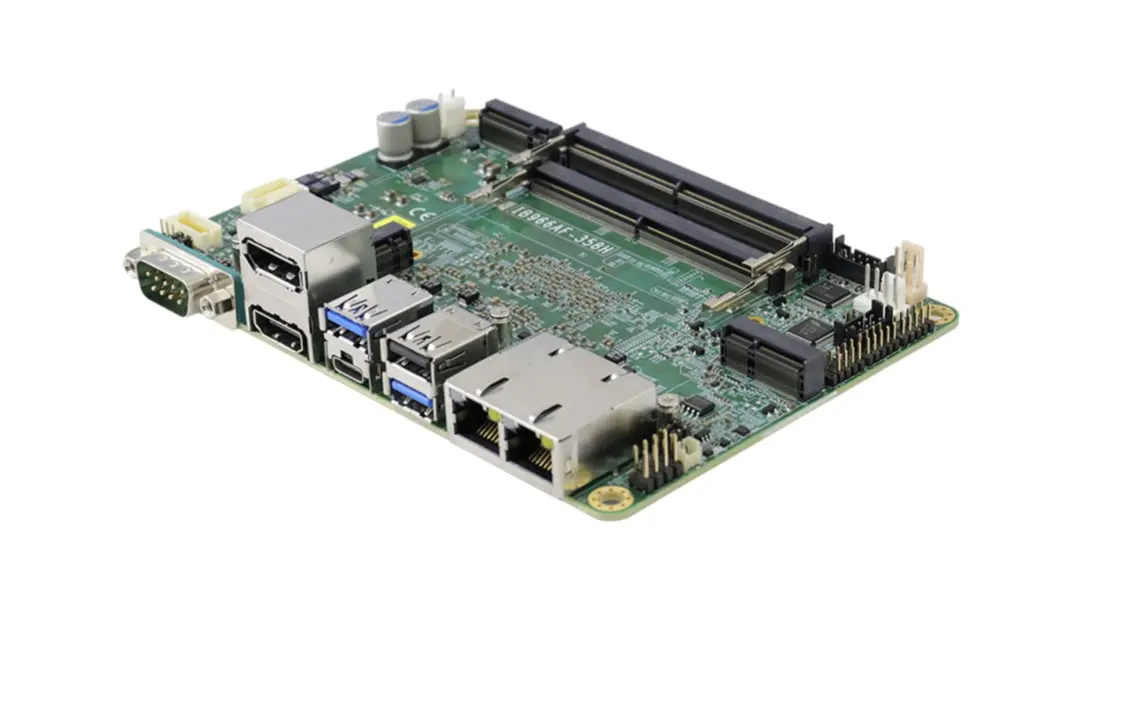
IBASE has officially released the IB966, a new 3.5-inch Single Board Computer designed for users who need high-performance computing in a compact footprint. This board matters because it brings desktop-class Intel Panther Lake processors to the small form factor market, offering significant processing power where space is limited. Buyers looking for a powerful embedded solution now have a viable option that supports up to 128 GB of RAM.
IBASE introduces the IB966, a compact 3.5-inch single board computer
The system centers on Intel's latest Panther Lake architecture, supporting the 16-core Core Ultra X7 358H processor. Lower-end configurations are also available, featuring the 8-core Core Ultra 7 355 or the 16-core Core Ultra 7 356H. This range allows integrators to choose the exact balance of cores and power consumption required for their specific project.
Specifications
- CPU: Intel Core Ultra X7 358H (16-core)
- RAM: Up to 128 GB DDR5-7200
- Storage: 1x M.2 2280, 1x M.2 2242
- Network: Dual 2.5G LAN
- iGPU: Arc B390 (12 Xe3 cores)
Memory capacity reaches up to 128 GB via dual SODIMM slots, utilizing fast DDR5-7200 modules. Storage flexibility is provided through one M.2 2280 slot and one M.2 2242 slot for SSDs. Connectivity is robust, featuring dual 2.5G Ethernet ports alongside USB 3.2 Type-C, HDMI, LVDS, eDP, and COM ports.
Graphics performance varies significantly depending on the chosen CPU. The top-tier Core Ultra X7 358H includes an Arc B390 iGPU with 12 Xe3 cores, which performs at a level comparable to an RTX 4050 Laptop discrete GPU. In contrast, the Core Ultra 7 355 and 356H feature a much weaker iGPU with only 4 Xe3 cores. Multithreaded synthetic benchmarks suggest the Core Ultra X7 can keep pace with the Ryzen AI Max+ 388 APU.
Pricing and availability details remain unclear at this time. IBASE has not yet disclosed specific costs or release dates for the IB966. Users interested in this hardware will need to wait for further official announcements to determine if the board fits their budget and timeline.
Source: NotebookCheck
Discussion
0 comments