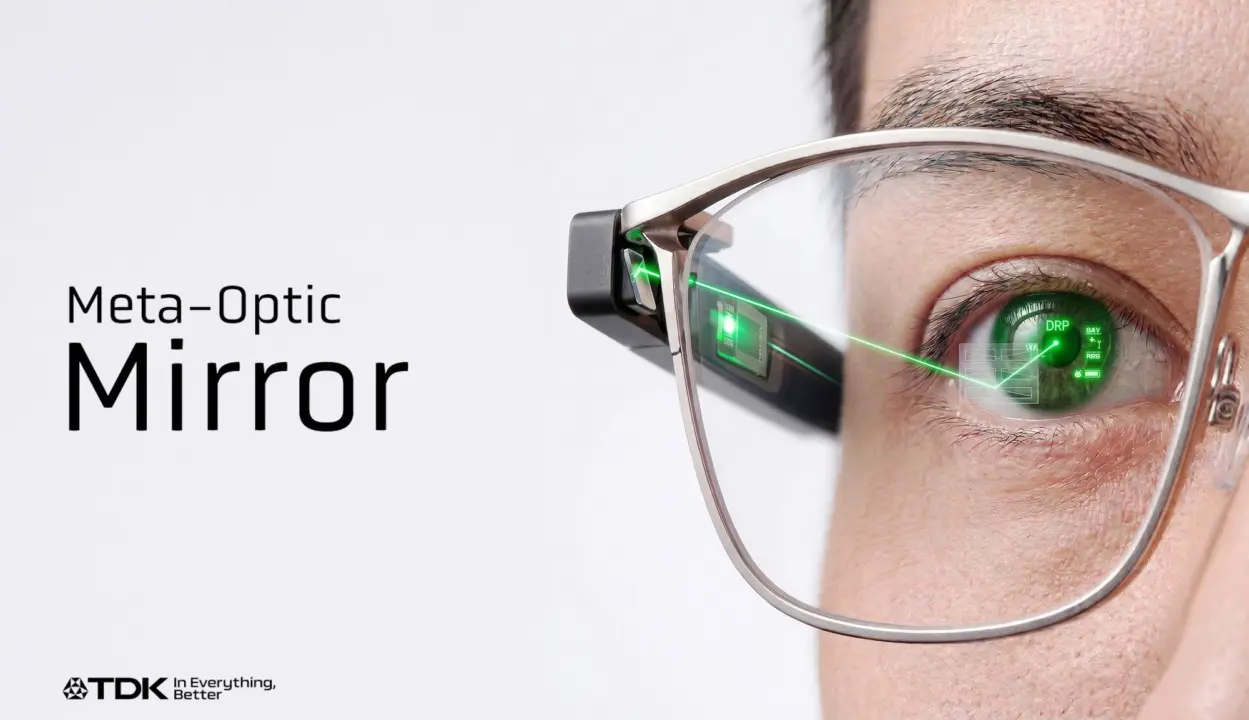
TDK has demonstrated a new display technology that projects images directly onto the wearer's retina, a shift that could remove the need for traditional lenses in smart glasses. This direct retinal projection approach aims to make wearable displays significantly thinner and more transparent than current options. Buyers interested in augmented reality should watch this development because it challenges the bulky lens designs that currently limit user comfort and style.
TDK demonstrates world's first direct retinal projection display for smart glasses
The core of this system is a meta-optic mirror that sits inside the eyewear lens. TDK says this is the world’s first direct retinal projection display for smart glasses using this specific mirror technology. The company is working with QD Laser to provide the RGB light sources and optical engines needed to drive the projection.
Specifications
- Mirror Thickness: 150 nm
- Light Transmittance: 80%
- Current Image Mode: Monochrome
- Target Resolution: 4K
- Display Technology: Direct Retinal Projection (DRP)
The meta-optic mirror is only 150 nanometers thick, which allows it to replace the bulkier curved mirrors found in older retinal-projection systems. TDK reports that the mirror transmits approximately 80 percent of visible light, keeping the glasses highly transparent for the wearer. The current prototype is limited to monochrome images, but the design is capable of supporting up to 4K resolution.
TDK claims the projected image is visible only to the wearer, which provides a layer of privacy not always present in other AR displays. The company also notes that the mirror can be manufactured using processes comparable to semiconductor production, potentially easing scalability compared to waveguide displays. TDK has not yet disclosed practical specifications such as brightness, field of view, or power consumption.
TDK will show the prototype at CEATEC 2026 in Japan, beginning October 13, and at Electronica 2026 from November 10 to 13. The company aims to demonstrate a full-color version and begin mass production within the next few years. No pricing information is available at this time.
Source: NotebookCheck
Discussion
0 comments