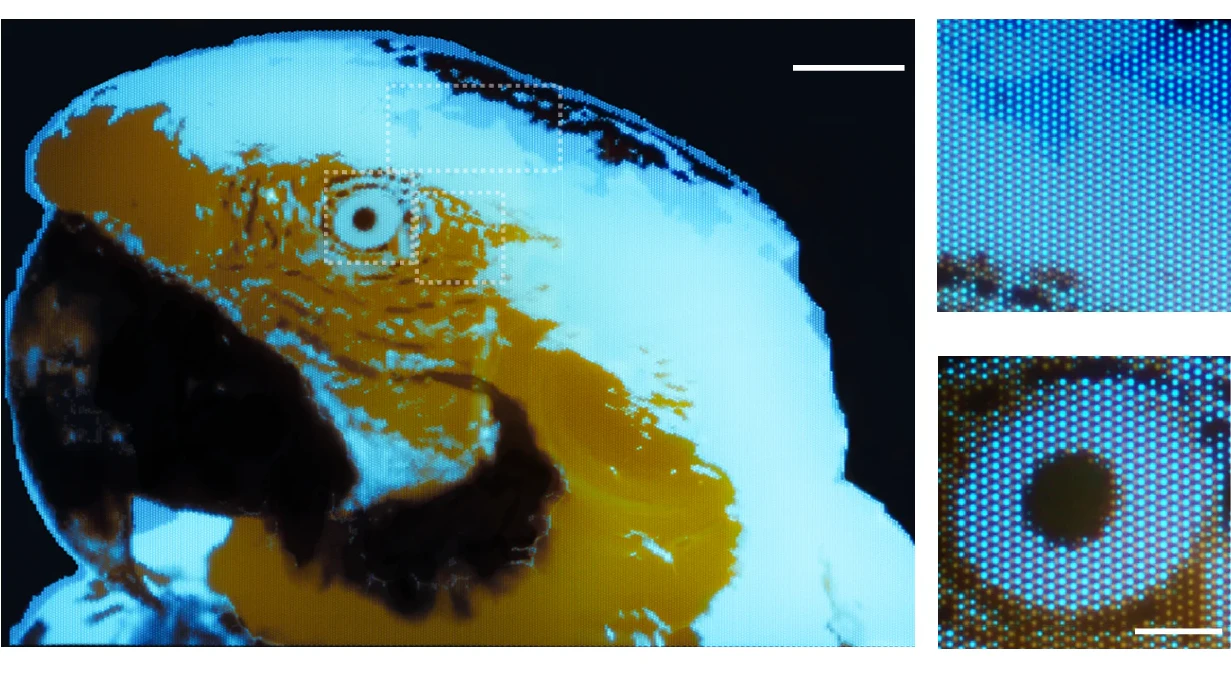
Researchers at ETH Zurich have developed a method to pattern ultra-small OLED displays using UV-photolithography, a technique that could facilitate the creation of microscopic screens for medical applications. The team developed luminescent polymers that survive the aggressive chemical etching used in standard UV-photolithography, a process previously incompatible with delicate light-emitting materials. The new polymer material allows for the patterning of light-emitting pixels using standard photolithography processes, similar to those used in semiconductor manufacturing.
Microscopic OLEDs could enable new medical applications
The research centers on a core-shell molecular structure that protects light-emitting molecules while allowing them to be precisely patterned during manufacturing. Researchers successfully created a multicolor macaw image measuring 300 by 430 micrometers using this technique. This specific test pattern contained 250 by 350 individual pixels, demonstrating the ability to resolve fine details at a microscopic scale. The researchers utilized a core-shell structure in the luminescent polymers to protect light-emitting molecules during the aggressive chemical processes of UV-photolithography.
Specifications
- Pixel Count: 250 by 350
- Image Dimensions: 300 by 430 micrometers
- Logo Dimensions: 1 by 2.4 millimeters
- Manufacturing Technique: UV-photolithography
In a separate experiment, the team produced a glowing ETH logo measuring 1 by 2.4 millimeters. This specific logo was electrically powered, proving that the material can function as an active light source when connected to electronics. The study was published in Nature on September 16, 2026, and also reported by EurekAlert. The study demonstrated both high-resolution patterning of a multicolor image and the electrical operation of a separate glowing logo, showcasing the potential of the polymer approach.
The current technology is not yet a functional display for consumer use because the pixels currently fluoresce when illuminated externally rather than producing light electrically. Electronics for independent pixel control are not yet developed for these ultra-small scales. While the material foundation has been established, the technology is not yet a functional display because the pixels currently fluoresce when illuminated externally rather than producing light electrically. The research establishes the material basis for tiny OLEDs, but independent pixel control and electronics are not yet developed.
Source: NotebookCheck
Discussion
0 comments