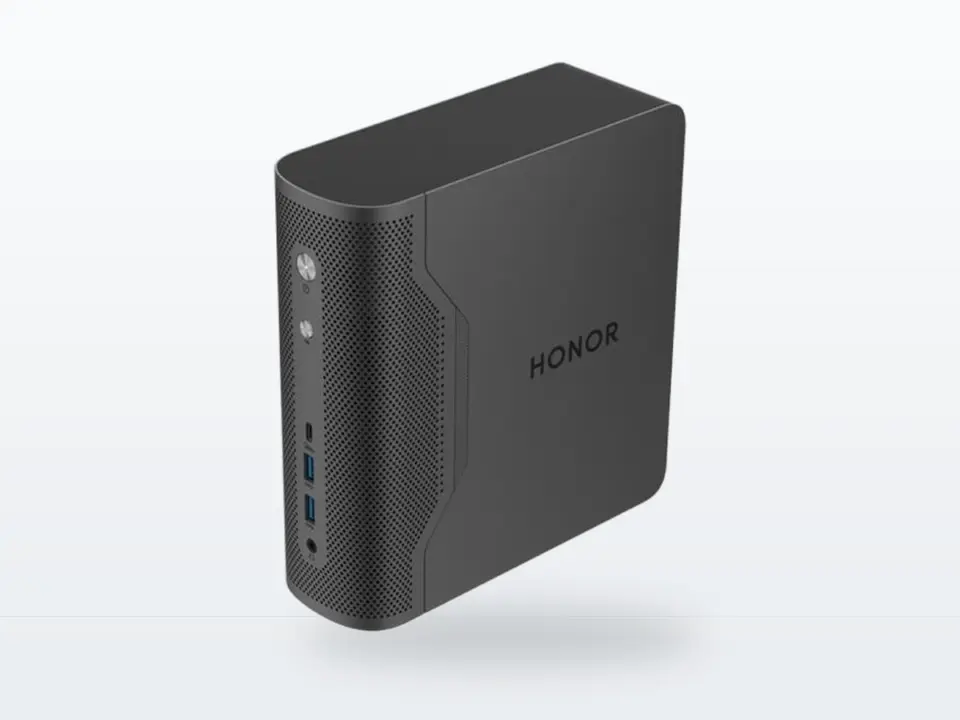
Honor has introduced the Tiangong AXB35, a compact AI workstation designed to bring large language model deployment to smaller footprints. This release matters because it offers a dedicated hardware path for running massive models locally without requiring server-grade rack space. Users who need high-throughput AI inference can now consider a desktop form factor that fits on a standard desk.
Compact desktop targets local LLM deployment with three distinct CPU configurations
The system comes in three distinct configurations to target different workload intensities. The Ultra variant leverages Nvidia's RTX Spark platform, which pairs a Blackwell-based GPU with a Grace CPU for unified memory access. The Standard model relies on an Intel Core Ultra X7 358H processor, while the Pro version utilizes an AMD Ryzen AI Max+ 395 chip.
Spec comparison
| Spec | Standard | Pro | Ultra |
|---|---|---|---|
| CPU | Intel Core Ultra X7 358H | AMD Ryzen AI Max+ 395 | Nvidia Grace (Blackwell GPU) |
| Memory | 64GB | 128GB | 128GB LPDDR5X |
| AI Performance | 180 TOPS | 126 TOPS | 1 PFLOP (FP4) |
| Storage | 2TB NVMe SSD | 2TB NVMe SSD | 2TB NVMe SSD |
Physical dimensions are kept tight at 2 liters, measuring 70 x 192 x 203 mm and weighing approximately 1.5 kg. Memory capacity scales with the tier, offering 64GB in the Standard model and up to 128GB of LPDDR5X unified memory in the Ultra and Pro versions. Storage is standardized across the lineup with a 2TB NVMe SSD included in every unit.
Connectivity options include dual 10GbE ports, Wi-Fi 7, two USB4 ports, four USB-A ports, HDMI 2.1, and DisplayPort 1.4. The Ultra configuration claims up to 1 PFLOP of FP4 AI performance according to Nvidia's specifications. Honor lists AI performance at up to 180 TOPS for the Intel setup and 126 TOPS for the AMD model.
The AXB35 supports both Windows 11 and Ubuntu operating systems, catering to enterprise and developer environments. Honor has not yet announced pricing or retail availability for any of the three models. Practical model capacity will depend on quantization methods, context length, and software optimization rather than raw hardware specs alone.
Source: Honor, NotebookCheck
Discussion
0 comments