
Remedy lifted the review embargo for the PC version of Control Resonant, and the results show a game that demands serious graphics hardware. The title is heavily GPU-bound, meaning your graphics card will hit 100 percent utilization even at 1080p resolution without advanced lighting effects. This matters because players with older or mid-range cards will need to rely on upscaling technologies to maintain playable frame rates. We looked at Control Resonant Confirmed for Steam Deck earlier while tracking NVIDIA launches, but the PC experience here is distinctly different in its resource hunger.
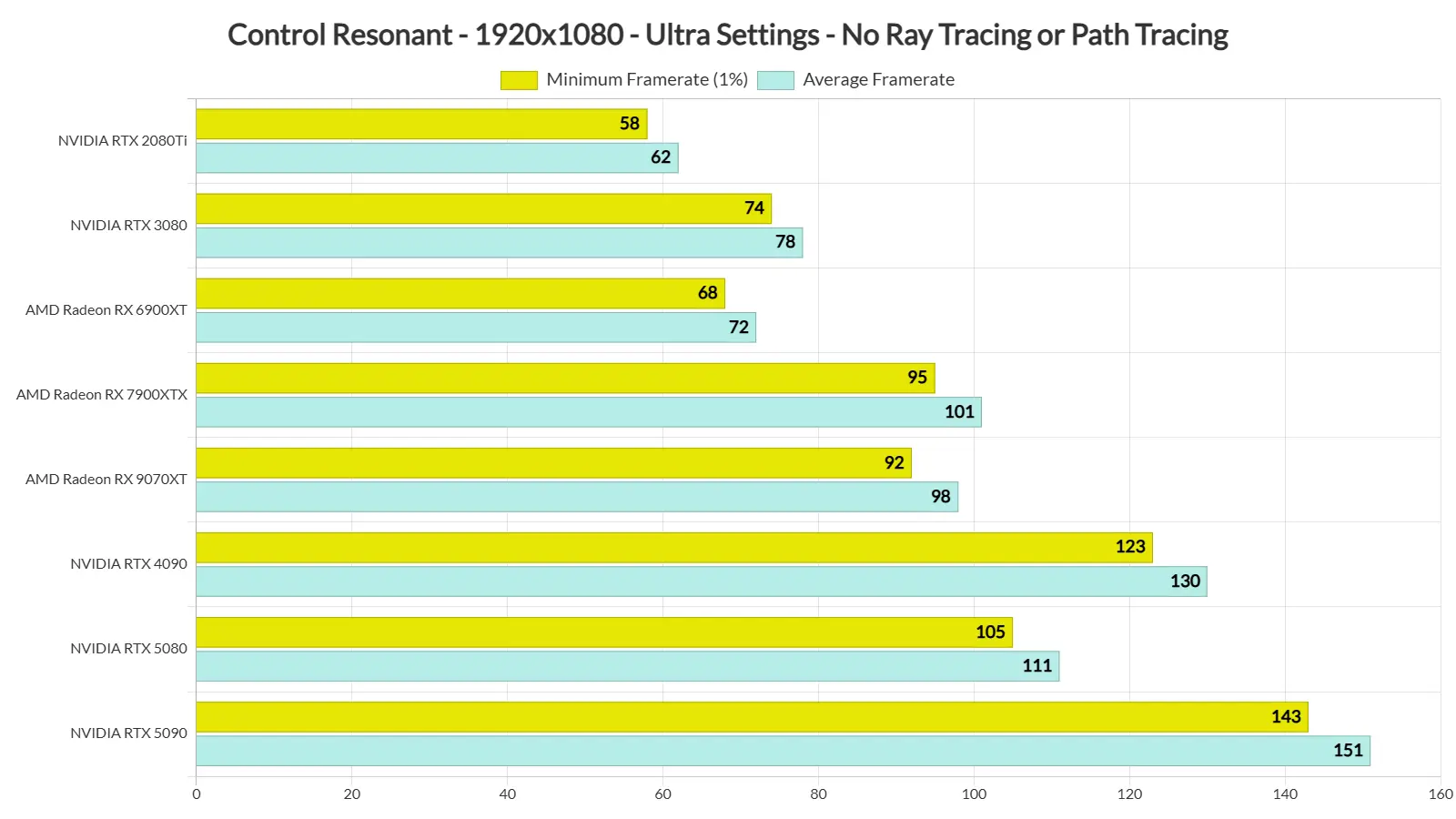
DLSS 4.5 restores playable frame rates on RTX 5080
Our testing configuration used an AMD Ryzen 9 7950X3D processor paired with 32GB of DDR5 memory running at 6000Mhz. We ran the game on Windows 10 64-bit using the latest GeForce 616.92 and Radeon Adrenalin Edition 26.9.1 drivers. The test suite covered a wide range of GPUs from AMD and NVIDIA, including the RX 6900XT, RX 7900XTX, and RX 9070XT. We also tested NVIDIA cards ranging from the RTX 2080Ti up to the RTX 5090 to see how different tiers handle the workload.
- Test CPU: AMD Ryzen 9 7950X3D
- Test RAM: 32GB DDR5 6000Mhz
- Test GPUs: AMD Radeon RX 6900XT, RX 7900XTX, RX 9070XT; NVIDIA RTX 2080Ti, RTX 3080, RTX 4090, RTX 5080, RTX 5090
- OS: Windows 10 64-bit
- Drivers: GeForce 616.92, Radeon Adrenalin Edition 26.9.1
The PC version supports both Ray Tracing and Path Tracing, along with NVIDIA DLSS 4.5 and AMD FSR 4 upscaling. Intel XeSS is not supported in this build. Without Ray Tracing or Path Tracing enabled, most of our tested GPUs could sustain over 60 FPS at 1080p on Ultra settings. The game becomes significantly more demanding at 1440p and 4K resolutions, where the hardware gap becomes very apparent. The reviewer noted that the game runs well on a wide range of GPUs at lower resolutions, but the upper limits are strict.
Native 4K performance without upscaling is only smooth on the NVIDIA RTX 5090. The RTX 5080 delivers about 100 FPS at 4K with DLSS 4.5 Performance in rasterized mode. Enabling Path Tracing cuts that performance in half, dropping the RTX 5080 to just 20-22 FPS at Native 4K. Turning on DLSS 4.5 Super Resolution brings the RTX 5080 back to 52-57 FPS with Path Tracing active. The reviewer stated that DLSS 4.5 is here to save the day for high-resolution gaming in this title.
We also noted a subjective visual complaint regarding the protagonist Dylan, who looked inferior to previous titles even on Ultra settings with Path Tracing. Despite the visual criticism, the hardware requirements are clear and the upscaling support is robust. Players should expect to use upscalers for high-resolution gameplay unless they own the top-tier RTX 5090. The game is available on PC and requires significant GPU power for the best experience.

Discussion
0 comments