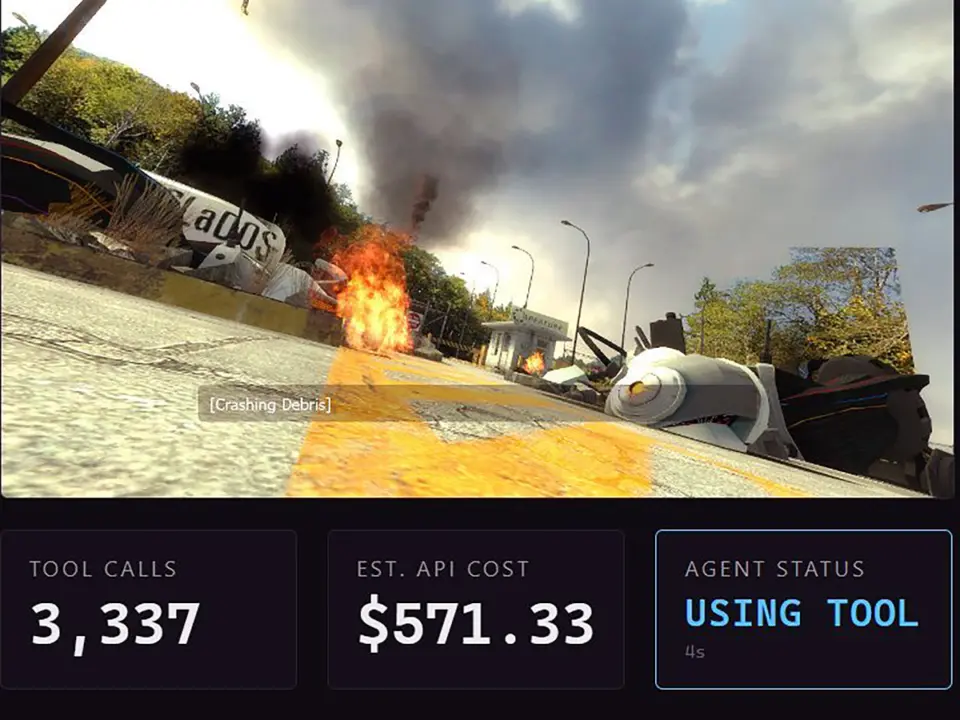
An AI model recently completed Valve's Portal without human help, showing that large language models can navigate complex 3D physics environments. This matters to players and developers because it proves that autonomous agents can handle spatial reasoning tasks that previously required scripted AI or human input. The achievement marks a shift from text-based gaming to full graphical interaction.
The AI model navigated complex 3D physics using modified tools and minimal API costs
The run used OpenAI's GPT-6 Astra model, which the source describes as the company's new flagship AI. An enthusiast known as CozyBlaze set the model loose on the full 3D puzzle game. The AI played without any walkthroughs or scripted assistance, relying solely on its own reasoning capabilities.
The AI used a modified SourcePauseTool and the Model Context Protocol to handle button presses. It froze the game while reasoning through puzzles, then executed commands to move forward. This approach allowed the model to interact with the game's physics engine in real time.
The entire run took about 24 hours of raw gameplay time, which was trimmed to a two-hour video for demonstration. The process required approximately 3,300 API tool calls. These calls cost less than $600 in API fees, making the experiment relatively affordable for large-scale testing.
We looked at the last Portal update earlier while tracking Valve's development trends. The themes of balance and stability in that update contrast with the new challenges posed by autonomous AI agents. This comparison highlights how game design adapts to both human and machine players.
The source explicitly states that the AI ran the full 3D puzzle game without a walkthrough or scripted assist. This confirms that the model achieved the feat through independent decision-making rather than pre-programmed solutions. The result demonstrates significant progress in agentic behavior within physics-driven environments.
Source: NotebookCheck
Discussion
0 comments