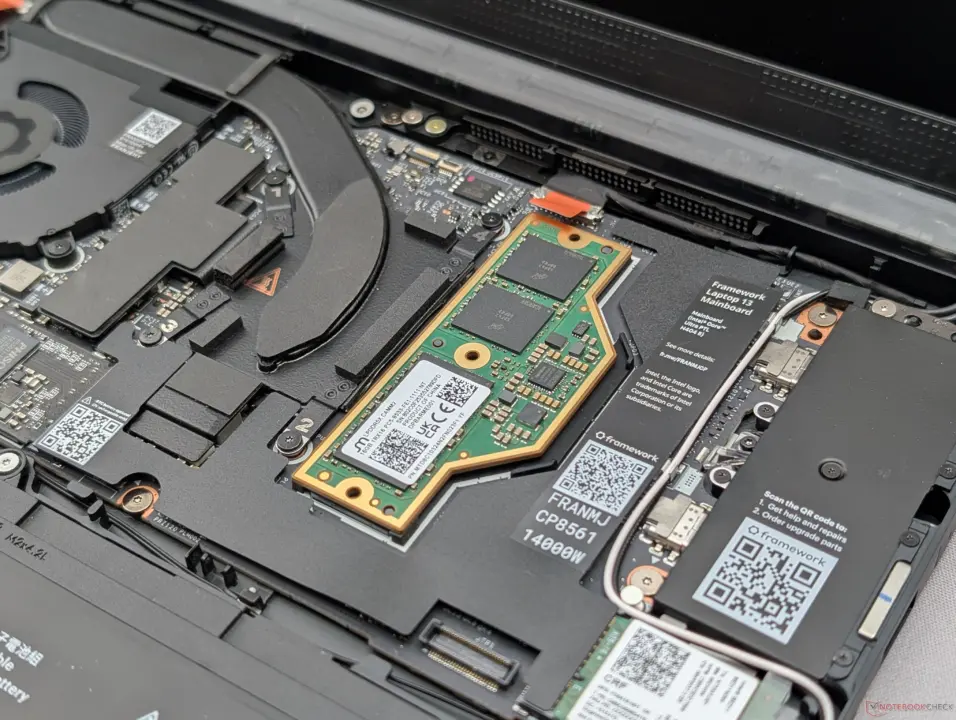
Framework has opened pre-orders for the Laptop 13 Pro, introducing a significant shift in memory architecture that directly impacts buyer costs. The new Intel configurations utilize the newer LPCAMM2 standard, while AMD models continue with traditional DDR5 SODIMM modules. This divergence creates a stark price difference for equivalent memory capacities, forcing users to weigh speed against value. Buyers seeking maximum memory capacity or budget efficiency will find the AMD path more logical, while Intel users pay a premium for higher transfer rates.
AMD configurations offer significantly better performance per dollar
The laptop is available with Intel Core Ultra 3 Panther Lake processors or AMD Ryzen AI 300 Zen 5 chips. Intel versions are restricted to the LPCAMM2 form factor, which supports memory speeds up to 7467 MT/s. AMD versions rely on standard DDR5 SODIMM slots, capping memory speeds at 5600 MT/s. This hardware split defines the two distinct configuration paths available to consumers.
Specifications
- Intel RAM Type: LPCAMM2
- Intel Max RAM Capacity: 64 GB
- Intel Max RAM Speed: 7467 MT/s
- AMD Max RAM Capacity: 96 GB
- AMD Max RAM Speed: 5600 MT/s
Memory capacity limits also differ between the two platforms. The Intel LPCAMM2 configuration tops out at 64 GB of RAM. In contrast, the AMD DDR5 setup supports up to 96 GB of memory. This 32 GB gap allows AMD users to run more demanding workloads that exceed the Intel memory ceiling.
Pricing highlights the cost disparity between these memory technologies. A 64 GB Intel configuration costs $1600. The same 64 GB capacity on an AMD system costs $810 when configured with two 32 GB DDR5 modules. The author notes that configuring with the 64 GB LPCAMM2 module will cost $1600 compared to "only" $810 when configuring with two 32 GB DDR5 SODIMM modules. This price gap makes the AMD option significantly stronger on a performance-per-dollar basis. Framework does not appear to use the space saved by LPCAMM2 for larger cooling solutions or other features.
The Framework Laptop 13 Pro is now available for pre-order globally. We've been tracking Framework Laptop 13 Pro closely — see our earlier coverage on Framework Laptop 13 Pro RAM Prices. The decision between Intel and AMD now hinges on whether the higher memory speed justifies the doubled cost for the same capacity.
Source: NotebookCheck