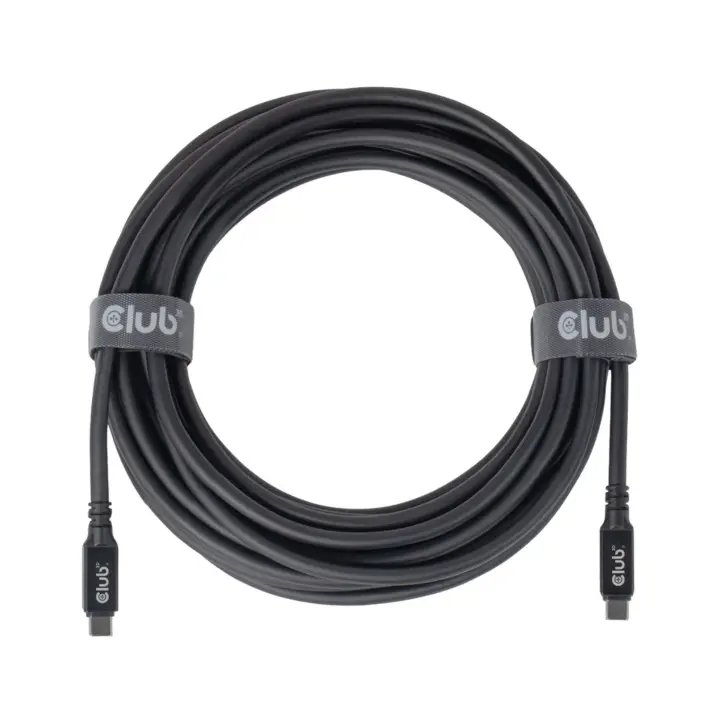
Club3D has released a 30-foot USB4 cable that challenges standard power delivery limits, a move that matters to users who need long-range connectivity without active signal boosters. The CAC-2509 ships as a passive cable, which typically means it cannot maintain high-speed data transfer over such distances without additional power or amplification. Buyers who rely on extended USB-C runs for docks or monitors should note that this product operates outside standard certification requirements. This non-standard approach allows for greater length but introduces potential reliability concerns for critical setups.
Non-certified 30-foot passive cable targets niche long-range setups
The device functions as a direct extension for USB4 connections, supporting a data rate of 20 Gbps across the full 30-foot span. It delivers up to 100W of power delivery, which exceeds the standard 60W limit for many USB-C implementations while falling short of the 240W USB PD 3.1 specification. Club3D also introduced the CAC-2507 adapter, which allows users to connect two standard USB-C cables to achieve even greater lengths than the single CAC-2509 cable provides. These accessories are designed for setups where standard cable lengths are too short for desk or rack configurations.
Specifications
- Interface: USB4
- Data Rate: 20 Gbps
- Length: 30 ft
- Power Delivery: 100W
- Cable Type: Passive
Technical specifications for the CAC-2509 include a passive design that relies on the connected devices to manage signal integrity over the long wire. The cable carries a 100W power rating, which creates a conflict with USB-IF standards that define power delivery in discrete steps of 60W or 240W. Because this wattage does not fit the standard profile, the CAC-2509 is not certified by the USB Implementers Forum. This lack of certification means the product does not guarantee compliance with official USB4 interoperability tests.
Initial retailers are listing the CAC-2509 for over $100 USD (around $100), a price point that reflects the specialized nature of long passive cables. The high cost combined with the lack of certification suggests that this product targets niche users who prioritize length over guaranteed standard compliance. In our experience, particularly long USB-C cables are not always reliable, and the non-standard power delivery here may exacerbate stability issues. Users should confirm that their host and device combinations support the 100W power delivery before using this cable for critical tasks.
Source: Club3D, NotebookCheck