Intel Arc G3 specs confirmed with 14-core Panther Lake CPU and Xe3 graphics
Intel has introduced Arc G-Series, a new processor family for Windows 11 gaming handhelds. The first two models are Intel Arc G3 and Intel Arc G3 Extreme.
Both chips are based on Intel Core Ultra Series 3, also known as Panther Lake. Intel is using the Arc name for the full handheld processor, not only for the integrated graphics.
First systems from Acer, MSI and OneXPlayer
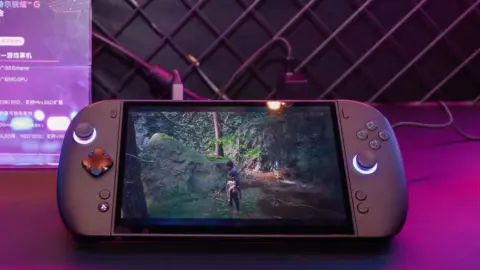
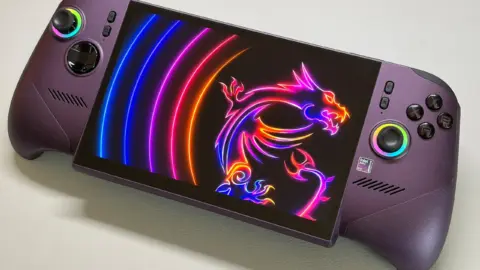
Intel says the first handhelds using Arc G-Series processors will come from Acer, MSI and OneXPlayer. The company names Acer Predator Atlas 8, MSI Claw 8 EX AI+ and OneXPlayer as early partner systems.
Systems based on Arc G-Series processors are scheduled to start rolling out from OEM partners in June 2026. Intel says more details will be shared at Computex 2026, with more systems planned later this year.


14 CPU cores and 25W base power
Both Arc G3 processors use the same CPU configuration. Intel lists 14 cores and 14 threads, with 2 Performance-cores, 8 Efficient-cores and 4 Low Power Efficient-cores.
Arc G3 Extreme boosts up to 4.7 GHz. The standard Arc G3 reaches up to 4.6 GHz. Both chips have 12MB of Intel Smart Cache.
Intel lists the same power figures for both SKUs. Processor Base Power is 25W, Maximum Turbo Power is 80W and Minimum Assured Power is 15W. Final performance will depend on cooling, firmware tuning and OEM power profiles.
Arc B390 and Arc B370 graphics
The main difference is the GPU. Arc G3 Extreme uses Intel Arc B390 graphics with 12 Xe3 cores. Arc G3 uses Intel Arc B370 graphics with 10 Xe3 cores.
Arc B390 reaches up to 2.3 GHz and is rated at 113 INT8 TOPS. Arc B370 reaches up to 2.2 GHz and is rated at 90 INT8 TOPS.
Intel lists TSMC N3E as the GPU lithography for both chips. Both GPUs support ray tracing, DirectX 12 Ultimate, OpenGL 4.6 and OpenCL 3.0.
Media support includes AV1 encode and decode, H.264 encode and decode, H.265 encode and decode and H.266 VVC decode-only. Intel Quick Sync Video is also supported.
XeSS 3 and Xbox Mode support
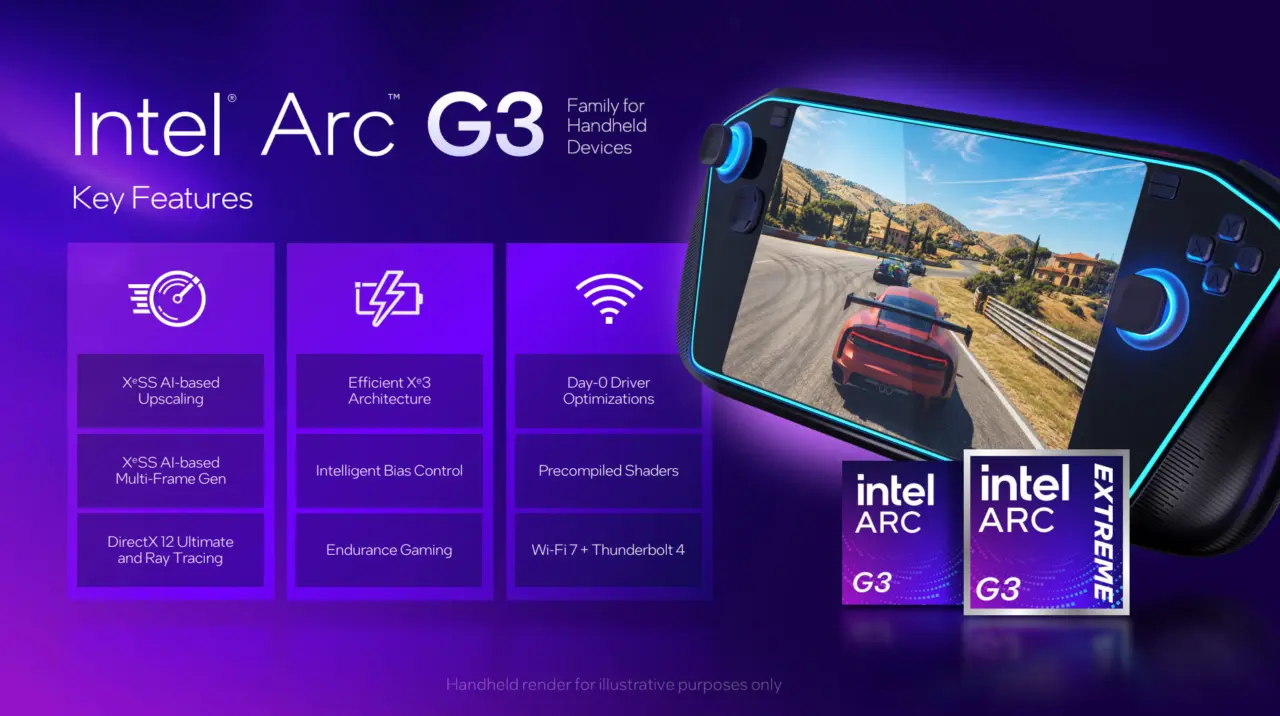
Intel is tying Arc G-Series to XeSS 3. The feature set includes XeSS Super Resolution, XeSS Multi-Frame Generation and Xe Low Latency.
XeSS Super Resolution is Intel’s AI upscaling technology. XeSS Multi-Frame Generation adds interpolated frames. Xe Low Latency is meant to reduce input latency in supported games.
Intel also lists Day-0 driver support for new game releases. Another feature is Intel Precompiled Shaders, which downloads prebuilt shader files from Intel cloud storage for select games.
Arc G-Series handhelds also support Xbox Mode for Windows 11 PCs. This is Microsoft’s controller-optimized full-screen interface, made for handheld systems without a keyboard or mouse.
46 TOPS NPU and LPDDR5X-8533 memory
Both Arc G3 processors include a 46 INT8 TOPS NPU. Intel lists sparsity support and Windows Studio Effects support.
The chips support up to 96GB of LPDDR5X-8533 memory across two channels. Actual handheld configurations will depend on OEM board designs, price targets and battery capacity.
Intel also confirms Thunderbolt 4 support, PCIe 5.0 and PCIe 4.0. The platform supports up to 12 PCIe lanes.
Display output support includes eDP 1.5, DisplayPort 2.1 UHBR20 and HDMI 2.1 FRL. Intel lists support for up to two displays, with up to 7680×4320 at 60Hz over DisplayPort and up to 3840×2400 at 120Hz over eDP.
| Intel Arc G3 official specifications | ||
|---|---|---|
| VideoCardz.com | Intel Arc G3 Extreme | Intel Arc G3 |
| CPU architecture | Panther Lake, Intel 18A | Panther Lake, Intel 18A |
| CPU cores / threads | 14 cores / 14 threads | 14 cores / 14 threads |
| CPU layout | 2 P-Cores, 8 E-Cores, 4 LP E-Cores | 2 P-Cores, 8 E-Cores, 4 LP E-Cores |
| Max CPU boost | 4.7 GHz | 4.6 GHz |
| P-Core boost | Up to 4.7 GHz | Up to 4.6 GHz |
| E-Core boost | Up to 3.4 GHz | Up to 3.3 GHz |
| LP E-Core boost | Up to 3.1 GHz | Up to 3.1 GHz |
| Cache | 12MB Intel Smart Cache | 12MB Intel Smart Cache |
| Processor Base Power | 25W | 25W |
| Maximum Turbo Power | 80W | 80W |
| Minimum Assured Power | 15W | 15W |
| Graphics | Intel Arc B390 | Intel Arc B370 |
| GPU architecture | Xe3, TSMC N3E | Xe3, TSMC N3E |
| Xe cores | 12 | 10 |
| GPU clock | Up to 2.3 GHz | Up to 2.2 GHz |
| GPU AI performance | 113 INT8 TOPS | 90 INT8 TOPS |
| Ray tracing | Yes | Yes |
| Graphics API support | DirectX 12 Ultimate, OpenGL 4.6, OpenCL 3.0 | DirectX 12 Ultimate, OpenGL 4.6, OpenCL 3.0 |
| Memory support | Up to 96GB LPDDR5X-8533 | Up to 96GB LPDDR5X-8533 |
| Memory channels | 2 | 2 |
| NPU performance | 46 INT8 TOPS | 46 INT8 TOPS |
| Display output | eDP 1.5, DisplayPort 2.1 UHBR20, HDMI 2.1 FRL | eDP 1.5, DisplayPort 2.1 UHBR20, HDMI 2.1 FRL |
| Max DisplayPort resolution | 7680×4320 at 60Hz | 7680×4320 at 60Hz |
| Max eDP resolution | 3840×2400 at 120Hz | 3840×2400 at 120Hz |
| Media engine | AV1, H.264 and H.265 encode/decode, H.266 decode | AV1, H.264 and H.265 encode/decode, H.266 decode |
| I/O | Thunderbolt 4, PCIe 5.0 and PCIe 4.0 | Thunderbolt 4, PCIe 5.0 and PCIe 4.0 |
| PCIe lanes | Up to 12 | Up to 12 |
| Package | FCBGA2540, 50mm × 25mm | FCBGA2540, 50mm × 25mm |
Same package, different graphics tier
Both chips use the FCBGA2540 package. Intel lists the package size as 50mm by 25mm and the maximum operating temperature as 100°C.
The shared package and power limits suggest that OEMs can use Arc G3 and Arc G3 Extreme in similar chassis designs. The difference comes from graphics, where Arc G3 Extreme gets the 12-core Arc B390 GPU and Arc G3 gets the 10-core Arc B370 GPU.
Intel has not announced suggested processor pricing. Retail pricing will come from OEM handhelds, where display, battery, memory, storage and cooling can change the final system price.
Arc G-Series is Intel’s clearest handheld-focused PC gaming processor linup so far. The official specs confirm the CPU and GPU split, but battery life and sustained gaming performance will depend on each device design.
Sources: Intel Newsroom