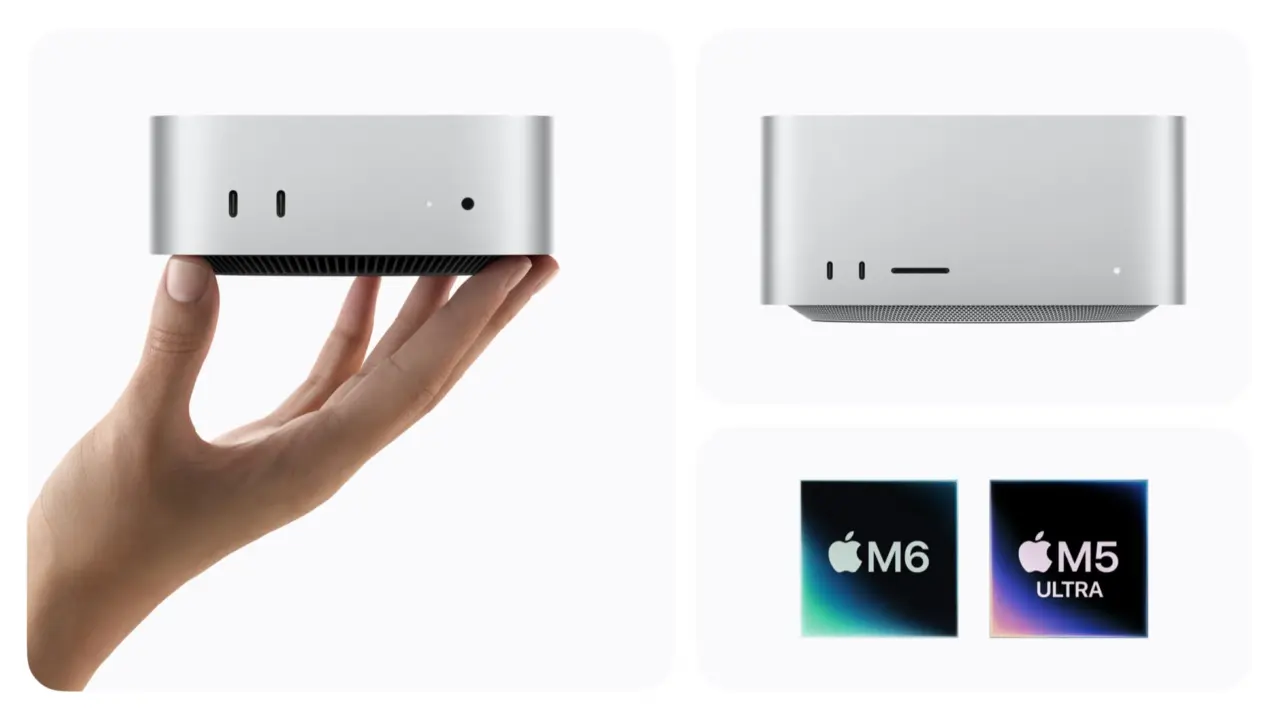
Apple removed the ability to upgrade storage on its latest Mac mini models, a change that raises the cost of ownership for buyers who need more than the base capacity. The new M6 and M5 Pro Mac Mini units feature NAND chips soldered directly to the logic board, which eliminates the internal slot used for removable storage modules. This design shift closes the cheaper third-party upgrade path that existed with the previous M4 generation, forcing users to pay Apple's premium prices or stick with the base configuration.
Apple removes storage slot in new models, forcing expensive official upgrades
The hardware change affects the M6 and M5 Pro Mac Mini specifically, reversing the modular design Apple introduced in 2024. While the M4 Mac Mini kept a removable storage module that allowed for aftermarket upgrades, the new models return to a fixed storage solution. This means existing M4 aftermarket modules will not fit into the new machines, and owners of the newer chips cannot swap in higher-capacity drives from third-party vendors.
- Storage Configuration (M6/M5 Pro Mac Mini): NAND soldered directly to logic board; no removable storage slot
- Storage Configuration (M4 Mac Mini): Removable module (not standard M.2)
- Storage Configuration (Mac Studio M5 Max/Ultra): Removable Apple-specific flash modules
- Aftermarket Upgrade Cost (M4 1TB): $300
- Apple Config Cost (M6 1TB): $500
The cost difference between official and third-party upgrades highlights the financial impact of this design decision. Expand Mac Mini sells a 1TB module for the M4 model for $300, and a 2TB version for $420. In contrast, Apple charges $500 to configure the M6 Mac mini with 1TB instead of 256GB, while moving to 2TB costs $1,000. These official prices are significantly higher than the aftermarket alternatives available for the previous generation.
Apple's repair documentation for the M5 Max and M5 Ultra Mac Studio models shows that their storage modules remain removable, distinguishing the Studio line from the Mac mini. However, these are Apple-specific flash modules that require macOS for restoration, and the documentation does not confirm whether higher-capacity sets can be installed as an upgrade. Expand Mac Mini currently considers aftermarket upgrades for the new Mac mini models unlikely due to the soldered NAND, though they do not explicitly state they are impossible.
This update follows the previous Mac mini update where we saw various accessories attempt to address storage and expansion needs. The current shift to soldered storage in the M6 and M5 Pro models removes that flexibility for standard Mac mini buyers. Users who require more than 256GB of storage must now choose between Apple's expensive official configurations or sticking with the base model.
Source: NotebookCheck



Discussion
0 comments