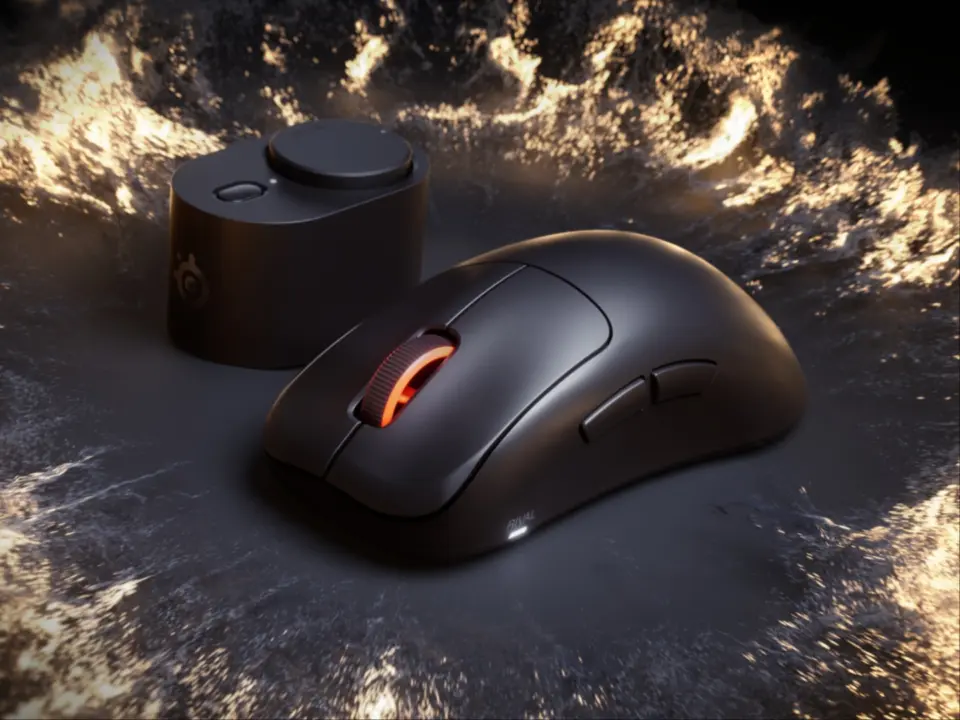
SteelSeries is updating its high-end gaming mouse lineup with the Sensei Pro and Rival Pro, shifting from traditional wireless to ultra-wideband technology. This move targets competitive players who need the lowest possible input lag and a connection that does not suffer from interference. Buyers looking for the fastest response times in fast-paced shooters should pay attention to these new specifications.
SteelSeries updates its high-end gaming mouse lineup with the Sensei Pro and Rival Pro, shifting from traditional wireless to ultra-wideband technology.
The new series includes the standard Sensei Pro with a symmetrical shape and the Rival Pro with an ergonomic design. SteelSeries claims the ultra-wideband connection offers a more open frequency spectrum than standard 2.4 GHz wireless, which should result in a more stable and responsive link to your PC.
Spec comparison
| Spec | Sensei Pro / Rival Pro | Sensei Pro Mini / Rival Pro Mini |
|---|---|---|
| Connectivity | UWB 8K | UWB 8K |
| Sensor | TrueMove 42K Pro | TrueMove 42K Pro |
| Polling Rate | 8K (9K Over-Polling) | 8K (9K Over-Polling) |
| Weight | 53 grams | 49 grams |
| Price | $180 | $180 |
Both mice run on the TrueMove 42K Pro sensor, which is a customized version of the PixArt PAW3955 chip. The hardware supports a polling rate of 8K with a claimed 9K over-polling mode and delivers a click latency of just 0.35 milliseconds. Optical switches rated for 100 million clicks handle the input signals.
Power comes from swappable 310 mAh batteries that last up to 16 hours at 8K polling or 60 hours at 1K polling. The standard models weigh 53 grams, while the smaller Sensei Pro Mini and Rival Pro Mini weigh 49 grams, with white variants adding one gram. SteelSeries prices both models at $180, with availability starting on October 13.
Source: NotebookCheck

Discussion
0 comments