Gamers building a PC around the AMD Ryzen 7 9800X3D can stop worrying about buying the fastest RAM sticks on the market. Our analysis of recent benchmarks shows that memory speed has almost zero impact on gaming performance for this specific processor. This finding matters because it allows builders to save money on cheaper memory kits without sacrificing frame rates. The CPU's massive 64MB L3 cache handles data delivery so efficiently that high-speed DRAM becomes largely redundant for gaming workloads.
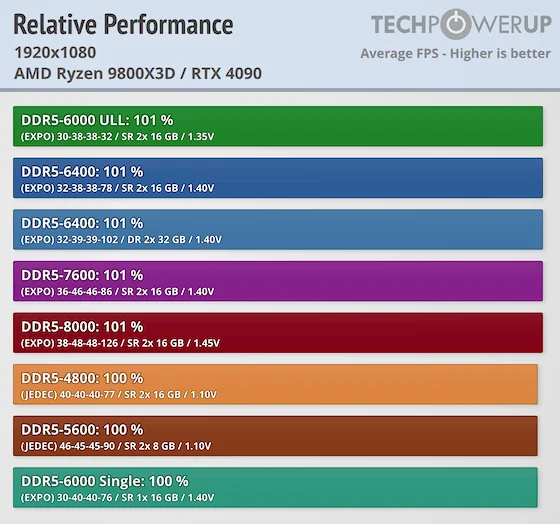
Tests show memory speed has almost zero impact on gaming performance
TechPowerUp conducted a rigorous test of the Ryzen 7 9800X3D using eight different DDR5 memory configurations. The testing range stretched from entry-level DDR5-4800 speeds all the way up to high-end DDR5-8000 kits. We evaluated performance across eight popular games including Palworld, Baldur's Gate 3, Elden Ring, Resident Evil 9, Spider-Man Remastered, Forza Horizon 6, Counter-Strike 2, and Cyberpunk 2077. The test bench paired the CPU with an RTX 4090 to ensure the GPU never became a bottleneck.
The results reveal that the fastest memory kits performed only 2% better on average than the slowest kits. Even upgrading to a DDR5-6000 Ultra Low Latency kit provided just a 2% gain over a basic DDR5-4800 JEDEC kit. These tiny differences fall within the margin of error for most gaming benchmarks. The 3D V-Cache architecture significantly reduces the processor's dependence on memory bandwidth compared to other CPUs on the market.
These tests covered 1080p, 1440p, and 4K resolutions to ensure consistency across different display settings. The performance delta remained negligible regardless of the resolution or the specific game title. This confirms that the Ryzen 7 9800X3D is uniquely tolerant of lower-speed memory configurations. Builders can prioritize other components like storage or cooling without fearing a performance penalty from standard RAM. We've been tracking Ryzen 7 9800X3D closely — see our earlier coverage on Ryzen 7 9800X3D Temp Drop.
The data confirms that high-speed DDR5 offers no practical advantage for gaming on the Ryzen 7 9800X3D. Users should feel confident purchasing affordable DDR5-4800 or DDR5-5200 kits. This flexibility simplifies system building and reduces overall costs for gamers. The processor delivers consistent performance regardless of memory speed choices.
Source: TweakTown

Discussion
0 comments