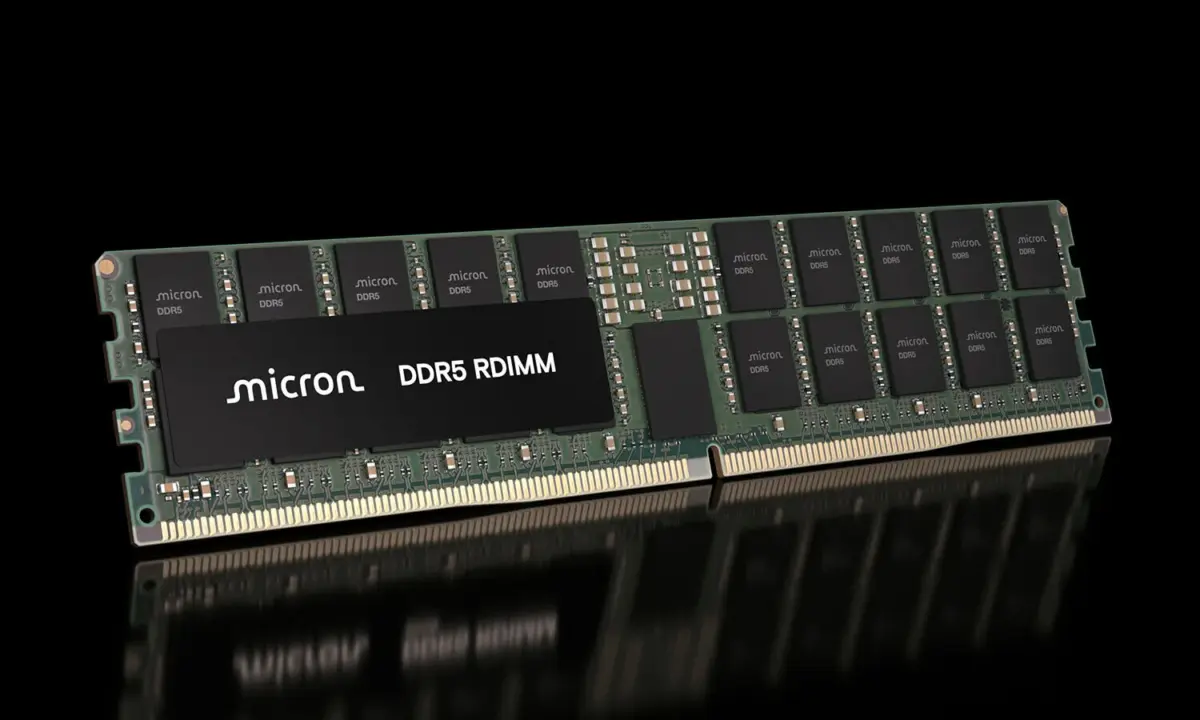
Server memory is about to get a massive capacity jump that could simplify how data centers are built. Micron demonstrated the world's first 512GB DDR5 RDIMM, a module that packs twice the capacity of the current 256GB standard into a single stick. This density matters because it allows administrators to fill server slots with far more memory while using fewer physical modules. Fewer sticks mean simpler cable management and potentially lower power costs for large-scale deployments.
Stacked DRAM architecture enables higher density and efficiency
The module relies on vertically stacked DRAM dies connected with through-silicon vias to achieve this density. Micron says the module will offer speeds of up to 9,200 MT/s, which supports high-bandwidth workloads. The company expects its 512GB DDR5 RDIMMs to enter volume production in the second half of 2027. AMD and Intel are currently validating the module for their next-generation server platforms.
Specifications
- Capacity: 512GB
- Type: DDR5 RDIMM
- Speed: Up to 9,200 MT/s
- Power: 16W
- Production: Second half of 2027
One 512GB RDIMM is rated at 16W, which is a significant efficiency gain over older configurations. Micron claims this design consumes more than 60% less power than an equivalent setup using four 128GB modules. The vertically stacked architecture reduces the electrical distance signals must travel, which helps maintain stability at high speeds. This power efficiency is critical for data centers trying to reduce cooling costs and energy bills.
Micron expects the 512GB modules to deliver up to 1.4 times the performance of systems using 256GB DDR5 configurations in Spark SVM-based data analytics. The company also expects benefits for platforms such as RocksDB and Redis, including higher throughput and improved concurrency. Actual performance will depend on the specific workload and server hardware used in each environment. These gains make the module particularly attractive for AI, database, and simulation tasks.
Data center operators will need to wait until the second half of 2027 to access this technology. The module is designed for global availability once production begins. Early validation by major CPU vendors suggests the hardware will integrate smoothly into upcoming server architectures. Buyers focused on maximizing memory density per socket should monitor this release closely.
Source: Micron, NotebookCheck


Discussion
0 comments